
Why Digital Transformation Often Falls Short of Expectations
Why Digital Transformation Doesn’t Always Improve Decision-Making
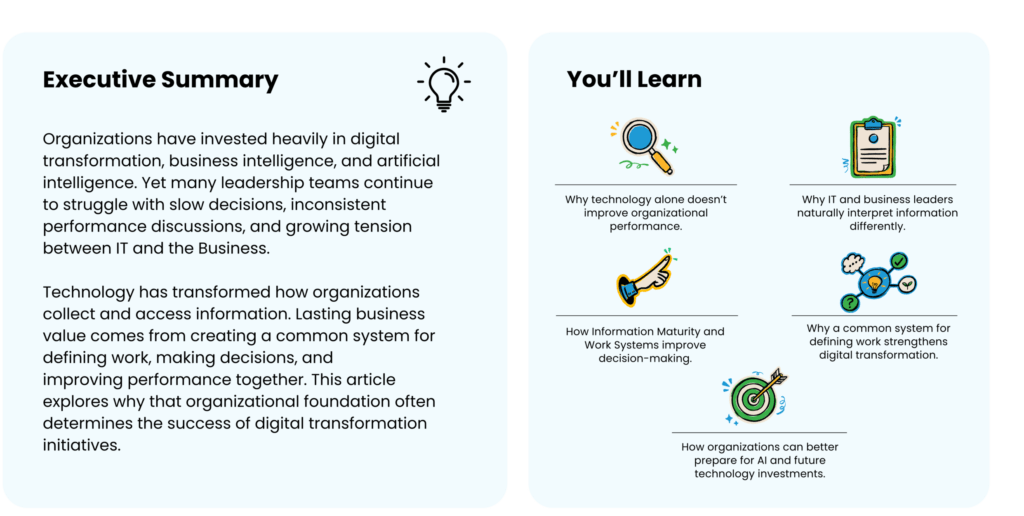
Over the past decade, organizations have invested heavily in digital transformation. Enterprise systems have become more capable, reporting has become faster, and business intelligence platforms have made information more accessible than ever before. More recently, artificial intelligence has accelerated those capabilities even further, allowing leaders to summarize, analyze, and distribute information at a speed that would have been difficult to imagine only a few years ago.
Despite those advances, many leadership teams continue having conversations that feel surprisingly familiar.
Sales and Operations interpret the forecast differently. Finance questions whether the right measures inform an important decision. Leadership spends valuable time reconciling reports before discussing what action should be taken. Decisions that initially appeared straightforward become more difficult because different departments are working from different assumptions about the business.
These situations rarely suggest the technology has failed. In many organizations, the systems are functioning exactly as intended. Information is available, reports are accurate, and dashboards are delivering the data they were designed to provide.
What those systems cannot establish is a shared understanding of how the organization should interpret that information.
Technology makes information easier to collect, organize, and distribute. Determining what deserves attention, how success should be measured, and how competing priorities should be balanced remains the responsibility of leadership. Those conversations require people from different parts of the organization to work through different perspectives together, something technology can support but cannot create on its own.
That distinction explains why many digital transformation initiatives successfully implement new technology while falling short of the broader business outcomes leaders expected.
Why IT and Business Leaders Often Interpret the Same Information Differently
One pattern we’ve observed across organizations is that different departments rarely experience the business in exactly the same way. In many respects, they shouldn’t.
Each department is evaluating the business through the lens of its own responsibilities. Those differences are not signs of poor communication or organizational dysfunction. They reflect the reality that every function contributes something different to organizational performance. Many of the strongest decisions emerge because leaders are willing to consider those different perspectives before moving forward.
The relationship between IT and the Business often illustrates this especially well. Business leaders are focused on serving customers, improving operations, and helping the organization respond to changing conditions. IT is responsible for building systems that are secure, reliable, and capable of supporting the business over the long term. Both groups want stronger organizational performance, but they naturally evaluate success through different responsibilities.
That difference in perspective often becomes visible during everyday work.
A business leader may ask why a report can’t be available sooner because an operational decision depends on it. IT may be thinking about data quality, system performance, or the long-term impact of changing an established process. Operations may be focused on keeping work moving. Finance may be evaluating the financial implications of the same decision.
None of those perspectives are wrong. The difficulty begins when each group starts solving the problem from its own perspective without a common way to connect those perspectives back to the business.
Leadership meetings often reflect that reality. Different departments bring valid perspectives, but they are not always working from the same definition of the work, the same priorities, or the same measures of success. Instead of building on one another’s expertise, conversations can become focused on establishing what matters most before decisions can move forward.
The organizations we’ve seen navigate this complexity most effectively don’t expect every department to think alike. They create a common way of defining the work, establishing priorities, evaluating performance, and making decisions together. Technology becomes significantly more valuable because it supports that system instead of asking departments to create it on their own.
What One Furniture Distribution Company Taught Us About Digital Transformation
One experience from our work illustrates this challenge clearly.
We worked with a furniture distribution company that had invested significantly in technology over the years. Multiple systems had been implemented, information was readily available, and leadership had access to more reporting than ever before. From a technology standpoint, the organization had made meaningful progress.
Yet leadership wasn’t experiencing the progress they expected.
Better access to information had not made it easier to move the business forward. Different departments interpreted performance differently, leadership conversations often centered on establishing what the information meant, and important decisions took longer than they should.
The focus of our work shifted. Rather than asking what additional information the organization needed, we began asking different questions.
- How was the work being defined?
- How was performance being measured?
- Did departments share the same understanding of priorities?
- Were leadership teams making decisions from the same view of the business?
As those conversations became more consistent, priorities became clearer, performance measures were better understood, and departments developed greater confidence that they were making decisions from the same understanding of the business. Leadership spent less time interpreting information and more time deciding what to do next.
The technology itself had not fundamentally changed. The systems were the same. The reports were the same. What changed was the organization’s ability to use those tools through a shared way of working.
That observation has shaped much of our thinking ever since. Technology creates tremendous opportunities, but organizations consistently realize greater value from those investments when people first develop a common way to understand the work, interpret performance, and make decisions together.
Technology Is the Instrument. The Method Is the Sheet Music.
Technology is the instrument.
The method is the sheet music.
A room full of talented musicians can have exceptional instruments and remarkable skill. Without a common score, however, each musician interprets the music differently. Individual talent remains, but coordinated performance becomes much more difficult.
Organizations experience something similar.
Technology gives leaders access to more information than at any other point in history. Artificial intelligence, advanced analytics, automation, and business intelligence platforms continue expanding what organizations can measure and understand. Those advances create tremendous opportunities, but they do not establish a common understanding of the work or how decisions should be made.
That understanding begins when leadership teams answer a few fundamental questions together:
- What are we trying to accomplish?
- How should the work be performed?
- How will we know whether we’re successful?
- How will we continue improving as conditions change?
Answering those questions consistently requires a structured way for IT and the Business to define the work, evaluate performance, and make decisions together.
In Bridging the Gap: Aligning IT and the Business, we outline five practical ways organizations begin building that structure:
- Create a common Work System so departments have a shared approach for defining, prioritizing, executing, and improving work.
- Assess Information Maturity to identify where information, reporting, and decision-making are creating friction and establish a roadmap for improvement.
- Develop an Interval Map to align long-term business priorities with technology initiatives instead of managing projects independently.
- Establish Measurement Clarity so leaders agree on the business questions, the measures that matter, and the information needed before new reports or dashboards are built.
- Build consistent leadership routines through Meeting COMPASS® to regularly review performance, resolve issues, and keep IT and the Business moving in the same direction.
Together, these practices create a common system for connecting work, information, and decisions across the organization. Technology becomes more valuable because it is supporting that system rather than trying to create it.
How Artificial Intelligence Is Changing Digital Transformation
Artificial intelligence is quickly becoming part of everyday work. Organizations are using AI to summarize information, improve forecasting, automate reporting, support decision-making, and increase productivity. Those capabilities will continue expanding, creating significant opportunities across every part of the business.
Like every major technology investment before it, however, AI depends on the organization using it.
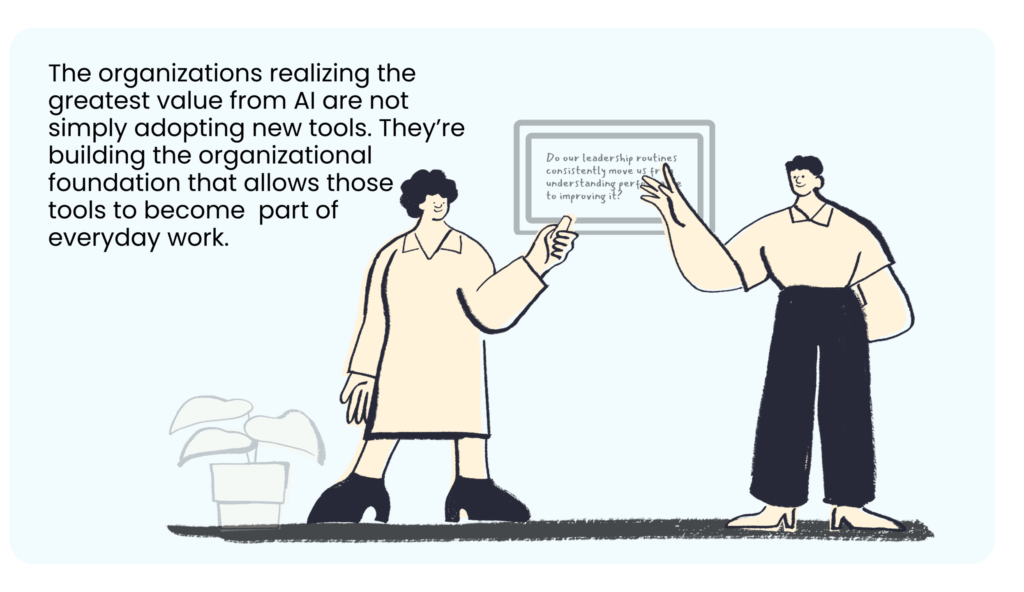
The organizations realizing the greatest value from AI are not simply adopting new tools. They are building the organizational foundation that allows those tools to become part of everyday work.
That foundation begins with Information Maturity. AI can only work from the information, definitions, and business context it receives. If departments define success differently, measure performance inconsistently, or interpret information through different assumptions, AI will reinforce those conditions rather than resolve them.
It also depends on clear Work Systems. AI is most valuable when it supports work that is already well understood. Organizations with clearly defined workflows, ownership, decision points, and measures of success are in a much stronger position to identify where AI can improve the work and how its impact should be evaluated over time.
Many organizations are asking what AI can do for their business.
An equally important question is whether the organization has established the foundation that allows AI to be used consistently across departments.
Without that foundation, AI often follows the same pattern as previous technology investments. The technology performs as expected, but the broader organizational outcomes fall short because the way people define, manage, and improve the work has not fundamentally changed.
Questions to Consider Before Your Next Technology Investment
- As organizations continue investing in digital transformation, analytics, and artificial intelligence, it may be worth asking a different set of questions before evaluating the next technology initiative.
- Do we have a common system for defining, prioritizing, and improving work across departments?
- Where does information create clarity, and where does it create confusion or conflicting interpretations?
- Are our technology initiatives clearly connected to long-term business priorities?
- Have we agreed on the business questions we are trying to answer before building reports, dashboards, or AI solutions?
- Do our leadership routines consistently move us from understanding performance to improving it?
There are no universal answers to these questions. Their value comes from the conversations they create. Leadership teams often discover that improving how people work together has as much influence on technology outcomes as the technology itself.
Final Thoughts
Digital transformation will continue evolving. Artificial intelligence will continue changing the way organizations access and analyze information. Those advances represent tremendous opportunities, but they do not change one fundamental reality.
Technology supports the way an organization works.
It does not define it.
Organizations continue separating themselves by creating a common way of working that allows people to interpret information consistently, work through different perspectives constructively, and make decisions with greater confidence.
Technology will continue changing.
The way organizations work together will continue determining whether those investments create lasting value.
Frequently Asked Questions About Digital Transformation and IT- Business Alignment
Why do digital transformation initiatives often fail to deliver expected business results?
Many organizations successfully implement new technology but continue making decisions through different priorities, measures, and ways of working. Technology improves access to information, but organizations realize greater business value when leaders also establish a consistent way to define work, evaluate performance, and make decisions together.
Why doesn’t better technology automatically improve decision-making?
Technology can make information easier to access, but it cannot determine what should be prioritized, how success should be measured, or how departments should work through different perspectives. Those are organizational capabilities that leadership must establish before technology can fully support them.
What is Information Maturity?
Information Maturity is an organization’s ability to consistently use information to support better decisions. It extends beyond data quality or reporting to include shared definitions, meaningful measures, clear ownership, and leadership routines that help departments interpret information consistently.
What is the relationship between IT and the Business during digital transformation?
IT and the Business bring different expertise to the same organizational goals. Business leaders focus on customers, operations, and growth, while IT focuses on building reliable, scalable systems. Organizations achieve stronger outcomes when those perspectives are connected through a common system for defining work and making decisions together.
How can organizations get more value from artificial intelligence?
Artificial intelligence performs best when it is introduced into organizations with strong Information Maturity and clearly defined Work Systems. When work is consistently defined, ownership is understood, and performance is measured the same way across departments, AI becomes much easier to integrate into everyday decision-making.
What should organizations do before investing in new dashboards, reporting tools, or AI?
Before investing in additional technology, leadership teams should evaluate whether the organization has a consistent way to define work, prioritize initiatives, measure performance, and improve across departments. Technology creates greater value when it supports those organizational capabilities rather than attempting to create them.
Continue the Conversation
If your organization is working to strengthen the relationship between IT and the Business, improve digital transformation outcomes, or prepare for the growing role of artificial intelligence, our white paper, Bridging the Gap: Aligning IT and the Business, explores these ideas in greater depth and outlines practical ways to create a more consistent approach to work, information, and decision-making.