
Why You Can’t Explain Margin Changes, Even With Data
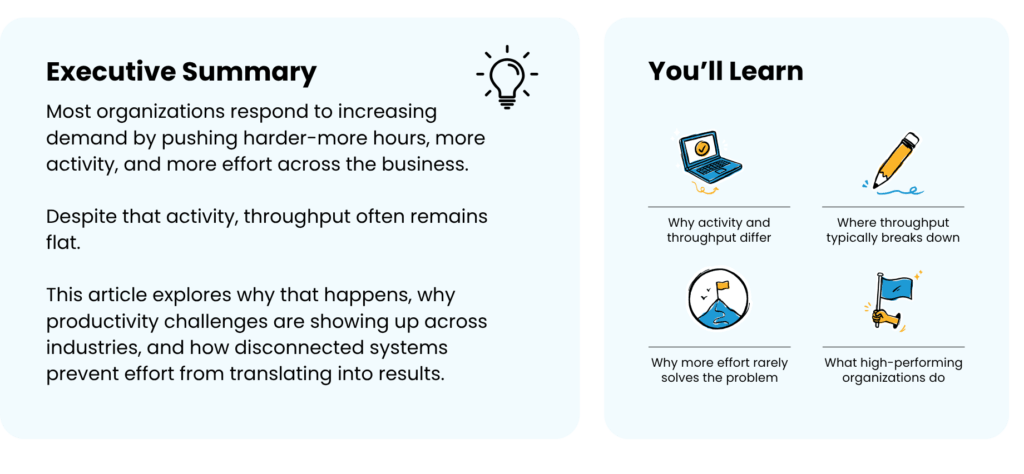
If your team is busy but performance isn’t improving, the issue may not be how the work is connected across the business.
Often times, leadership teams don’t question whether their people are working hard, because the effort is visible across the organization. Long hours, full schedules, and constant activity make it clear that teams are engaged in the work.
Despite that effort, something doesn’t add up.
Throughput isn’t improving, deadlines remain tight, margins stay under pressure, and output feels inconsistent. Over time, the question becomes harder to answer:
If everyone is busy, why isn’t performance improving?
The Reality: Activity Has Increased. Productivity Hasn’t.
This isn’t an isolated issue. Across manufacturing, construction, and distribution, productivity has remained flat, or in some cases declined, over the past several years.
Manufacturing productivity has remained essentially flat since 2019, with only modest gains of around 1–2% in recent years, according to U.S. Bureau of Labor Statistics data. Construction productivity has been declining for decades, with output per worker trending downward over time, according to industry analysis including Goldman Sachs research. Warehousing and distribution productivity dropped significantly in recent years, with only partial recovery, based on additional U.S. Bureau of Labor Statistics data.
At the same time, demand hasn’t slowed. In many organizations, there is more work than ever before. So, teams respond the only way they can: they work more. More hours, more effort, and more activity become the default response to growing demand. As the data shows, increased activity does not necessarily translate into improved throughput.
Why This Happens
There are real external pressures contributing to this dynamic.
Labor shortages mean fewer experienced workers are carrying more responsibility. Skills gaps slow down execution and increase errors. Technology investments don’t always translate into immediate gains due to integration and training challenges. With turnover, it may take longer for people to reach full proficiency, which continues to drag overall performance.
All these factors introduce friction into the system.
However, they don’t fully explain the difference in performance between organizations. Even in similar environments, facing similar constraints, some companies improve throughput while others remain stuck.
The Difference Isn’t Effort. It’s the System.
When throughput doesn’t improve, it is rarely because people aren’t working hard. More often, it is because the system they are working within is not fully connected.
Work increases, but flow does not.
Activity increases, but decision-making does not improve.
Data increases, but clarity does not follow.
This is where many organizations get stuck. They respond to pressure by pushing harder within the existing system, rather than stepping back to understand how that system is actually operating.
Where Throughput Breaks Down
When viewed through a system lens, the underlying patterns become clearer.
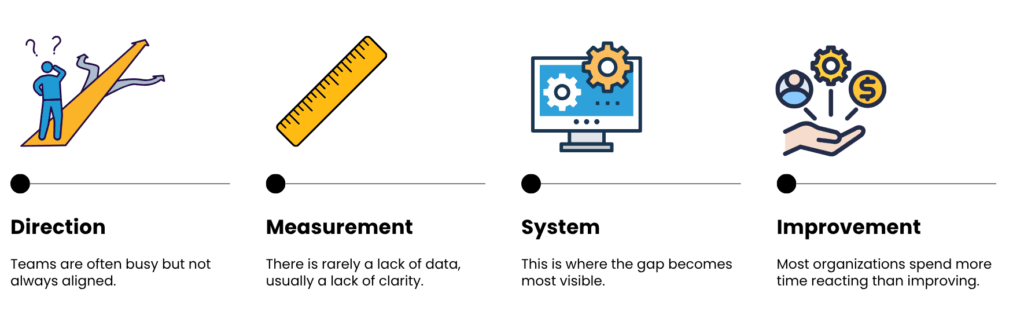
– 01 Direction
Teams are often busy but not always aligned.
Priorities shift, tradeoffs are unclear, and work expands to fill the gaps. As a result, effort becomes spread across too many initiatives, reducing focus and impact.
– 02 Measurement
There is rarely a lack of data.
However, many organizations track activity rather than outcomes, which makes it difficult to understand whether the work being done is actually improving performance. Teams stay busy but lack clarity on whether they are making meaningful progress.
– 03 System
This is where the gap becomes most visible. Work slows down, handoffs break, and rework increases.
In manufacturing, downtime, setup delays, and quality issues continue to drag throughput despite high labor input. In construction, fragmented scheduling and subcontractor dependencies create idle time even when crews are fully staffed. In distribution, high turnover and inconsistent labor allocation reduce effective output even when hours are high.
The work is happening, but it is not flowing consistently through the system.
– 04 Improvement
Most organizations spend more time reacting to issues than improving the system.
Problems are addressed in the moment, but the underlying causes remain unchanged. Over time, the same issues continue to surface, and performance plateaus.
The Pattern
When these elements are not connected, a predictable pattern emerges:
More work leads to more activity.
More activity creates more complexity.
More complexity slows execution.
And slower execution prevents throughput from improving.
The natural response is to work harder. Yet, the outcome does not change.
What High-Performing Teams Do Differently
Organizations that improve throughput do not start by increasing effort.
They start by stepping back. They look at how direction, measurement, system, and improvement connect, and they ask different questions:
Are we clear on what actually matters right now?
Are we measuring what drives throughput or just tracking activity?
Where is work slowing down or breaking?
What are we learning, and how are we adjusting the system as a result?
This approach is not about doing more work. It is about understanding how the business is actually operating. Once that becomes clear, effort begins to translate into results.
Where the Shift Starts
It can be difficult to recognize how disconnected these elements are until performance becomes hard to explain. For many organizations, that’s the moment leaders finally step back to better understand how the work is actually operating.
But that shift doesn’t have to wait for performance to decline.
The strongest organizations create space to step back earlier, before issues become visible in results. They take time to evaluate how direction, measurement, system, and improvement connect across the business. That shift in perspective is where throughput can begin to improve.