
How Operational Stability Creates Leadership Capacity
What Does It Mean to Work ON the Business?
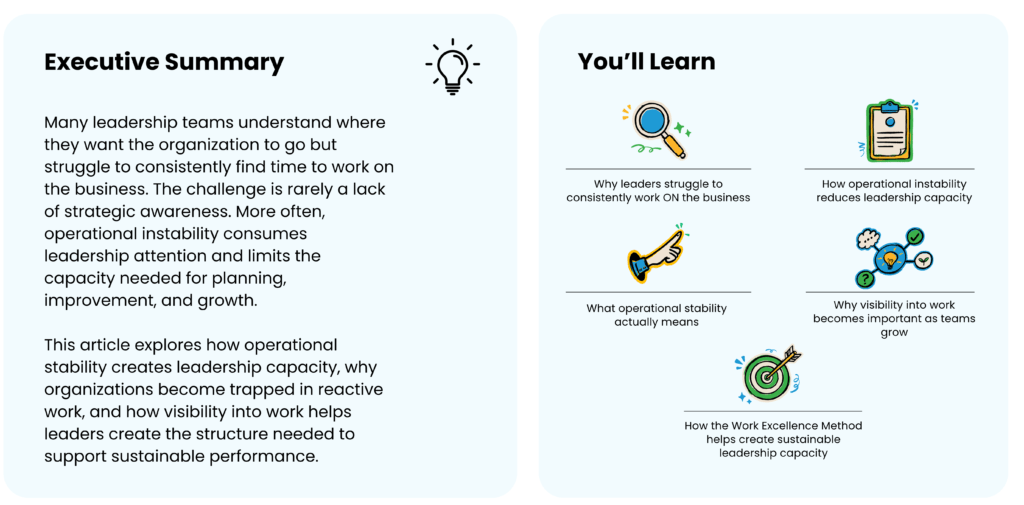
Working ON the business means intentionally improving how the organization operates rather than simply managing day-to-day execution. This includes activities such as strategic planning, leadership development, succession planning, operational improvement, capability building, and creating systems that support long-term performance.
Most leadership teams understand the importance of this work.
The challenge is creating enough operational stability to consistently focus on it.
Clearer Structure Creates Leadership Capacity
One of the most common things I hear from leadership teams is that they simply do not have enough time to work on the business.
The interesting part is that most leaders are clear on where they want the organization to go. They usually have a strong sense of the long-term vision. They know the business needs stronger systems, clearer priorities, leadership development, operational improvement, and better strategic planning. The issue is not typically a lack of awareness.
The issue is that operational instability continuously pulls leadership attention back into the business before there is enough time or capacity to consistently focus on those larger objectives.
Across industries, leadership teams are navigating a tremendous amount of operational pressure simultaneously. Staffing shortages, schedule changes, customer demands, margin pressure, supply chain instability, inventory challenges, and operational coordination issues all compete for leadership attention throughout the day. Over time, calendars become filled with meetings, escalations, and reactive problem-solving. Leaders spend more time stabilizing work than improving it.
This is where many organizations begin feeling stuck working in the business.
Not because the business lacks opportunity, but because instability consumes the leadership capacity required to step back and improve how the organization operates long term.
One of the challenges with operational instability is that it changes how leaders think and make decisions. When pressure remains consistently high, decision-making naturally becomes more reactive. Conversations focus on immediate issues. Priorities shift more frequently. Important strategic discussions get postponed because something operational always feels more urgent.
Over time, organizations start sacrificing strategic work without necessarily realizing it.
Leadership development gets delayed.
Succession planning gets delayed.
Improvement initiatives lose momentum.
Long-term strategic planning becomes fragmented.
Important structural conversations never fully happen because the organization is constantly responding to immediate operational demands.
I think this is one of the biggest reasons many organizations struggle to consistently work ON the business. Strategic capacity does not simply appear because leaders want it to. It requires operational conditions that create enough stability for leadership teams to think clearly, see patterns, and improve work intentionally over time.
Why Does Operational Stability Matter?
Operational stability does not mean the business is perfect or free from challenges. Every organization experiences disruption, variability, and unexpected issues.
Operational stability means the organization has enough consistency, structure, and visibility into work that leaders are not forced to react to every exception as it happens.
That distinction matters significantly.
When operations become more stable, leadership teams can begin shifting their attention from managing individual disruptions toward understanding the broader operating system itself. Instead of constantly asking, “How do we get through this week?” leaders gain the capacity to ask much more important questions.
Where are customers experiencing inconsistency?
What capabilities need to improve next?
What leadership structure will support future growth?
Where are we trying to go strategically, and does the business actually operate in a way that supports that direction?
Those are very different conversations.
And those conversations are difficult to have when leadership capacity is consumed by operational recovery work all day long.
Organizations often assume strategic work and operational work are separate. In reality, they are deeply connected. The ability to think strategically is heavily influenced by the operational conditions leaders experience every day.
When instability dominates the environment, leaders naturally focus on short-term decisions. When stability improves, leaders gain the capacity to think further ahead.
Why Visibility Into Work Creates Leadership Capacity
This is one of the reasons we focus so heavily on visibility into work through the Work Excellence Method.
In many organizations, the problem is not necessarily that leaders lack data or reporting. In fact, many leadership teams have more information than ever before.
The challenge is that the organization often lacks a shared way of seeing how work, priorities, workflows, measurement, and improvement efforts actually connect across the business.
As organizations grow, work becomes more fragmented. Departments operate from different assumptions. Priorities compete. Coordination requirements increase. Leaders spend increasing amounts of time trying to align people through meetings, conversations, and escalations because the operating system itself is no longer creating enough shared visibility or structure.
This is a common pattern in growing organizations.
More information becomes available, but understanding becomes more difficult.
Teams optimize locally while leaders struggle to understand how those efforts connect to broader organizational outcomes. Reporting increases, but visibility into the work itself often decreases.
Visibility into work creates a shared understanding of how the organization operates. It helps leaders see where priorities connect, where work flows effectively, where friction exists, and where improvement efforts should focus.
That visibility becomes increasingly valuable as complexity grows.
What Happens When Leadership Becomes the Coordination Layer?
Eventually, leadership becomes the coordination layer holding the organization together.
That may work for a period of time, especially in smaller organizations or founder-led businesses where leaders remain very close to the work.
But as scale increases, leadership capacity eventually becomes the constraint.
Leaders begin spending more time translating priorities, resolving confusion, coordinating between departments, and closing communication gaps.
The organization becomes increasingly dependent on individual leaders rather than the operating system itself.
At first, this often looks like strong leadership.
Over time, it becomes difficult to sustain.
When leadership becomes the primary mechanism for coordination, organizational performance becomes limited by the amount of attention leaders can provide. Growth creates more complexity, more decisions, and more coordination requirements than any individual leadership team can absorb.
This is one of the reasons operational maturity becomes increasingly important as organizations grow.
The goal is not to make leaders work harder.
The goal is to create enough structure that the work becomes easier to see, understand, and manage across the organization.
How Does the Work Excellence Method Create Leadership Capacity?
This is where the core elements of the Work Excellence Method become important because they help organizations create operational stability systematically instead of reactively.
Work Direction
Many organizations become reactive because priorities are not consistently clear across the business.
Different departments optimize different outcomes. Teams make tradeoffs differently. Urgency starts overriding strategic priorities.
Clarifying direction helps leadership teams create shared understanding around where the organization is trying to go, which outcomes matter most, and how operational decisions should support those objectives.
Work System
Operational instability often develops when workflows, ownership, and coordination become inconsistent across departments.
Handoffs weaken. Communication gaps increase. Teams compensate through informal workarounds and constant intervention.
Creating visibility into workflows and operational systems helps organizations improve consistency and reduce recurring friction inside execution itself.
Work Measurement
Many organizations measure activity extensively but still struggle to clearly interpret operational performance.
Different departments use different definitions. Reporting arrives too late. Metrics fail to connect operational conditions to business outcomes.
Shared measurement systems create clearer visibility into what the organization is actually experiencing operationally so leaders can respond earlier and with more confidence.
Work Improvement
One of the biggest operational traps organizations fall into is waiting for instability to become severe before improvement work begins.
By that point, leadership capacity is already consumed by operational recovery.
Improvement needs to become structured work inside the operating system itself rather than something teams attempt only when they “have time.”
Work Routine
The four core elements are held together by Work Routine.
This is often where long-term operational stability either develops or breaks down.
Strategic work requires consistent routines for reviewing work, aligning priorities, discussing operational conditions, and improving systems over time.
Without routines, organizations drift back toward reactive coordination because urgency naturally fills the space where structured improvement should exist.
Operational Stability and Strategic Growth Are Deeply Connected
What we consistently see is that as organizations improve visibility into work and strengthen these core elements, leadership capacity begins changing significantly.
Leaders spend less time reacting.
Decision-making becomes clearer.
Improvement work becomes more consistent.
Strategic conversations become more actionable because the organization finally has enough operational clarity to support them.
This is one of the biggest misconceptions around strategy and growth. Many organizations treat operational stability and strategic growth as separate conversations when they are actually deeply connected.
If the organization does not intentionally improve how work is structured, measured, aligned, and improved as complexity grows, operational instability eventually consumes the leadership capacity needed to sustain growth effectively.
Operational stability is what allows growth to become sustainable.
And in many organizations, strategic capacity is ultimately built through the difficult but necessary work of stepping back, creating visibility into how the business actually operates, and improving the system intentionally over time.
Key Takeaways
- Leadership capacity is often constrained by operational instability, not a lack of strategic awareness.
- Operational stability creates the conditions needed to work ON the business.
- Visibility into work helps leaders see patterns instead of reacting to exceptions.
- Growth becomes difficult to sustain when leadership becomes the primary coordination mechanism.
- Direction, System, Measurement, Improvement, and Routine work together to create long-term stability.
Want to Understand Where Leadership Capacity Is Being Lost?
Many organizations do not realize how much leadership capacity is consumed by operational instability until they step back and evaluate how work is actually functioning. Our Operational Diagnostic evaluates:
- Work Routine
- Work Direction
- Work System
- Work Measurement
- Work Improvement
In about 5 minutes, leaders receive a personalized executive report that highlights strengths, improvement opportunities, and potential areas where operational instability may be limiting organizational performance and growth.