
The Backlog Wasn’t the Problem. The Definition Was.
By Steve Gran
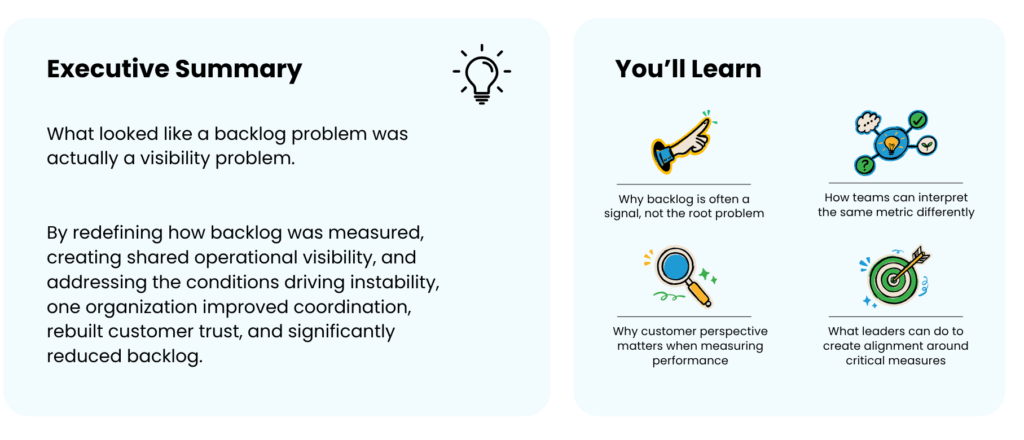
It is easy to assume backlog is a straightforward operational metric.
Often times, an increase backlog is interpreted as strong demand. A reduction in backlog may signal weaker sales or underutilized capacity. In many industrial organizations, backlog becomes one of the core measurements leadership teams use to evaluate operational health, forecast revenue, and assess future performance.
In reality, backlog is rarely as simple as it appears.
Backlog often blends multiple operational conditions:
- Future demand
- Delayed or constrained work
- Scheduling and workflow instability
- Labor or material shortages
- Customer and operational delays
The number itself may look clear on a report. The operational meaning behind it often is not.
I saw this firsthand while working with a company that was struggling with growing tension around backlog.
At first, the issue appeared operational. Leadership believed the backlog itself had become the problem. Timelines were slipping, customer frustration was increasing, and internal pressure was building across departments.
As we stepped back and looked deeper, it became clear that the real issue was not the backlog itself.
The issue was not that the organization lacked a backlog metric. The issue was that people were attaching different meaning to the same number.
- Sales saw backlog as a sign of future revenue and demand.
- Operations experienced backlog as scheduling pressure and execution complexity.
- Finance viewed backlog as an indicator of future performance and forecasting confidence.
- Customers experienced backlog through delayed deliveries, shifting timelines, and uncertainty.
At the leadership level, everyone was discussing the same number while operating from very different assumptions about what that number actually represented. They were looking at the same metric, but they were not having the same conversation.
As a result, operational friction began building across the business. Priorities became less consistent, planning became more reactive, and discussions around backlog often became increasingly emotional. Over time, confidence in the metric itself started to erode because leaders could not align on what it was really telling them.
This is far more common than many organizations realize. When teams lack a shared understanding of a critical measure, the conversation often shifts from managing
performance to debating the meaning of the metric itself. Many industrial organizations have backlog metrics, dashboards, and reports, but far fewer have established a shared operational framework for how backlog is defined, measured, managed, and interpreted across the business.
Questions such as when work officially enters backlog, how backlog aging should be measured, when backlog becomes operational risk, or how priority changes should be handled are often answered differently by different departments.
Without clear definitions and shared measurement rules, backlog can quickly become a source of confusion rather than visibility. That was exactly the situation this organization faced.
One of the most important discoveries was that customers often viewed backlog very differently than the organization did. Internally, backlog was largely measured from the point where work entered production scheduling or operational processing. Customers, however, often experienced backlog much earlier—from the moment an order was placed.
That distinction proved critical because it changed how leadership understood both the metric and the customer impact behind it. Two orders may appear identical on an internal report. From the customer’s perspective, they can feel completely different depending on communication, delivery reliability, and expectation management.
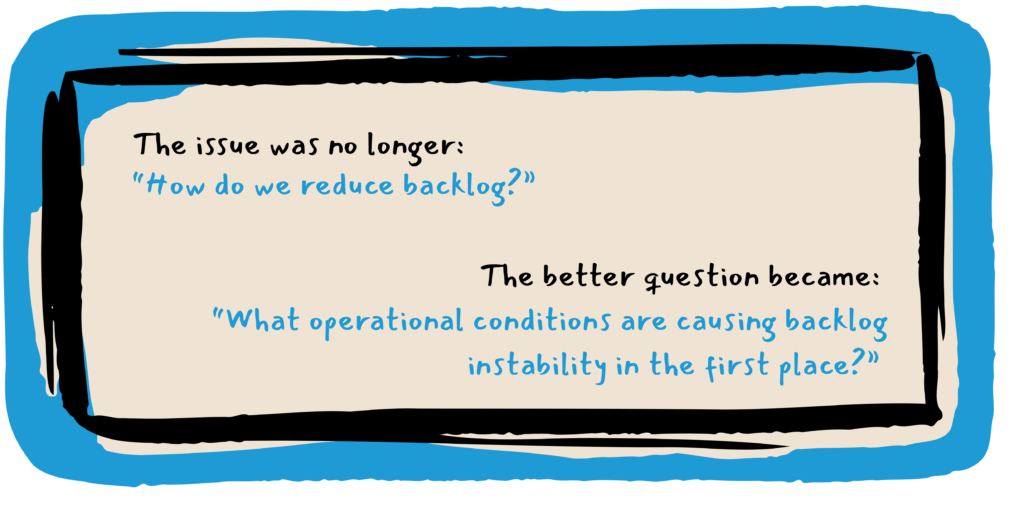
That changed the entire direction of the work.
Instead of reacting directly to the metric, leadership began examining the operational flow underneath it.
As we stepped back, several issues became visible:
- Inconsistent prioritization
- No shared definition of backlog between teams
- Unclear ownership and workflows
- Scheduling and planning instability
- Lack of shared operational visibility
What initially looked like a backlog problem was actually a visibility and coordination problem spread across the broader operating system.
This is one of the reasons backlogs have become so difficult for organizations to manage effectively. It is often treated as an isolated metric when it is actually deeply connected to workflow health throughout the business.
The backlog itself is frequently downstream from instability elsewhere in the organization.
Unfortunately, many companies respond by putting more pressure on the metric itself through production acceleration, increased overtime, expediting work, and adding more coordination meetings. Operational pressure intensifies across the organization, but if the underlying instability remains unresolved, the backlog usually returns.
This organization chose a different path.
Instead of simply trying to force backlog reduction through pressure, leadership made the decision to step back and examine how the business was actually operating. That required a significant amount of leadership courage.
It is not easy for leaders to acknowledge that a core operational measure may not be functioning in the way the organization believes it is. Especially when the metric has already become embedded in reporting structures, forecasting conversations, and executive expectations.
That willingness to question the measurement itself became one of the most important turning points in the process.
An improvement team was formed specifically to examine backlog from a broader operational perspective.
Together, the team worked to:
- Clarify how backlog was defined and measured
- Improve visibility into workflow and coordination issues
- Stabilize prioritization and scheduling routines
- Better align operational decisions with customer expectations
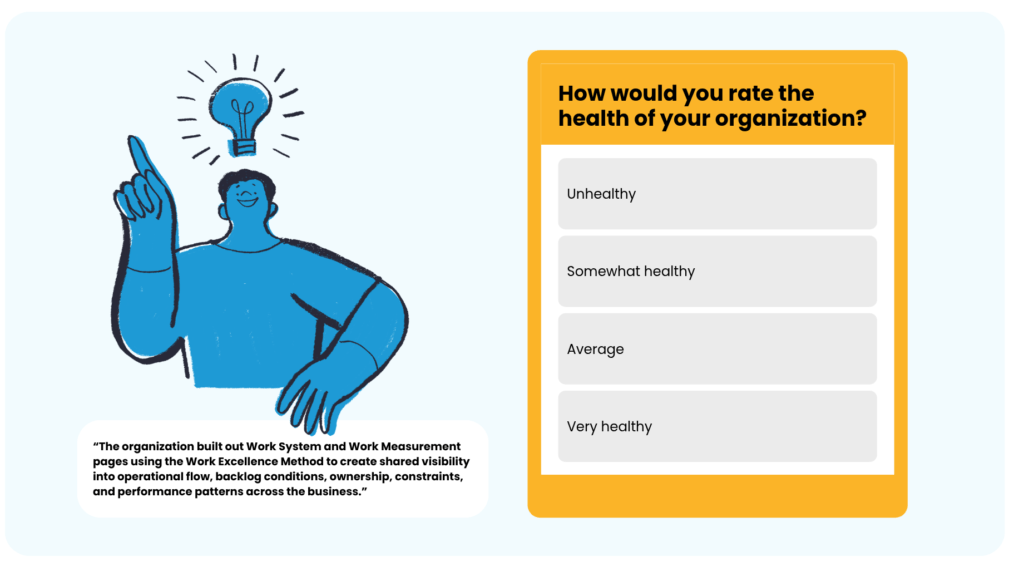
As part of the process, the organization built out Work System and Work Measurement pages using the Work Excellence Method to create shared visibility into operational flow, backlog conditions, ownership, constraints, and performance patterns across the business.
Many organizations struggle because core operational processes are often far less defined than leaders initially believe. The gaps only become visible once pressure increases, or customers begin feeling the effects of instability.
The goal is to build enough visibility into work that instability can be identified and addressed earlier.
Over time, the backlog was significantly reduced and eventually brought down to zero. More importantly, the organization gained a much clearer understanding of how operational flow, planning, scheduling, and customer expectations connected together across the business.
The results extended far beyond backlog reduction itself. Customer trust improved, communication became more consistent, and operational coordination strengthened across the business. Leadership teams became more proactive instead of constantly reacting to operational pressure.
In several cases, the way the organization handled the issue actually strengthened customer relationships. Customers saw the company responding transparently, improving communication, and addressing operational instability systematically instead of simply reacting to missed timelines.
Some customers ultimately increased business volume with the company because trust and confidence in operational execution improved significantly throughout the process.
That is an important operational lesson. Metrics like backlog, inventory, margin, downtime, and productivity rarely speak for themselves. Without shared definitions, visibility into work, and structured routines for interpreting operational signals, organizations often react to symptoms while the underlying instability continues growing underneath the surface.
Many operational problems do not begin when they first become visible. Backlogs are often one of the clearest examples of that.
The real challenge is identifying the conditions that create those outcomes before they begin impacting performance. Visibility into work, priorities, decision-making, and operational routines often reveals opportunities for improvement long before they appear in traditional metrics.
If you’re experiencing recurring backlog challenges, constant firefighting, or difficulty creating capacity to work on the business, our Operational Performance Assessment can help identify where operational complexity may be limiting performance and where your greatest opportunities for improvement exist.
This 15-question assessment evaluates your organization’s operational maturity across the core elements of the Work Excellence Method and provides a personalized report with insights to help guide your next steps.