
Why Sales Performance Becomes Less Predictable
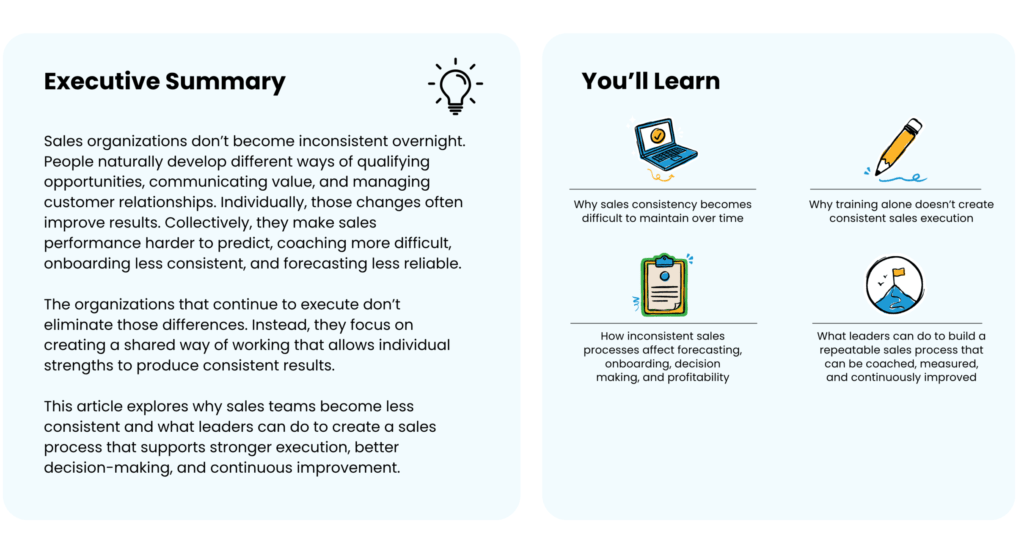
Sales Inconsistency Develops Gradually
Without a deliberate way to define, share, and continually improve the work, variation gradually replaces consistency.
Why Does Sales Performance Become Less Predictable
Sales performance becomes less predictable when the organization no longer has a
shared understanding of how sales work should be done.
Instead, people begin making different decisions about the work:
- Opportunities are qualified differently.
- Estimates are prepared using different approaches.
- Pricing decisions vary from one salesperson to another.
- Customer conversations move forward based on individual experience rather than a shared process.
Forecasts become conversations instead of commitments. Similar opportunities produce different outcomes. Execution is inconsistent because there is no common
standard for evaluating the work.
It becomes harder for leaders to confidently forecast, allocate resources, and improve the work.
Why Training Alone Doesn’t Create Consistency
The impact of training depends on what it’s reinforcing.
Training becomes far more valuable when it’s built on a common foundation. Leaders have a consistent way to define how work should be done, managers coach against shared expectations, and new employees learn a process the entire organization understands.
Instead of teaching individual preferences, training reinforces a shared way of working
that can be coached, measured, improved, and sustained over time.
A Sales Process Is Only as Strong as the System That Supports It
All organizations have some kind of sales process.
Documenting how sales work should be done is only the beginning.
Lasting consistency comes from creating a shared understanding of that work, reinforcing it through coaching and daily execution, measuring whether it’s producing
the intended results, and continually improving it over time.
We’ve found that organizations sustain consistency when people share a common understanding of these things:
- Purpose – How does the organization create value, and what defines a successful opportunity?
- Process – How should work move from one stage to the next?
- Performance – How will leaders know whether the process is working, and where should improvement efforts be focused?
When those questions are answered consistently, leaders spend less time reconnecting people around how work should be done and more time improving the work itself.
The goal is to create a common foundation that allows every salesperson to adapt to the customer while executing the work in a consistent way.
The Impact Extends Beyond the Sales Team
Inconsistent sales processes are often viewed as a sales management issue. In reality, they affect every part of the organization that depends on sales information to make decisions.
When opportunities are qualified differently, operations receives demand with varying levels of confidence. When estimating practices vary, similar projects require different levels of effort. When pricing decisions rely heavily on individual judgment, profitability becomes more difficult to manage.
These challenges create friction long before they appear in a revenue report.
Forecast meetings become discussions about interpretation rather than direction. Capacity planning becomes less reliable because the pipeline reflects different
qualification standards. Managers spend more time resolving exceptions, reconnecting departments, and clarifying priorities than improving the work itself.
A repeatable sales process creates a shared understanding of how work moves through the organization, how performance is evaluated, and where improvement
is needed. Instead of relying on constant leadership intervention, the organization has a common way of managing, measuring, and improving the work together.
What Does a Repeatable Sales Process Actually Look Like?
The strongest sales organizations create consistency without creating sameness.
Salespeople still build relationships differently. They ask different questions, communicate in their own style, and adapt to each customer. What they share is a common understanding of how the work should be done.

A repeatable sales process creates a shared understanding of the work.
- How do we create value for customers?
- What work needs to happen to move an opportunity from initial conversation to close?
- Who owns each step, and what does successful execution look like?
- How do we know the process is working?
- How do we improve the process as we learn?
Those answers create consistency beneath the customer conversation rather than scripting the conversation itself.
As organizations grow and change, that shared understanding becomes increasingly valuable. New employees have a process they can learn, managers have a common standard they can coach, and leaders have a foundation they can measure, improve, and continuously refine over time.
What One Manufacturer Learned About Sales Consistency
One manufacturer in the building and memorial products industry experienced many of the same challenges growing sales organizations face. The company had experienced salespeople, a strong reputation, and steady demand. The challenge wasn’t generating opportunities—it was managing them consistently.
Estimating practices varied across the team. Similar opportunities were evaluated differently, resources weren’t always matched to the complexity of the work, and leadership had limited visibility into how estimates were being managed. As a result, quote turnaround times became less predictable, estimate quality varied, and opportunities to improve profitability were often missed.
Rather than asking people to simply work faster, the organization partnered withWork Excellence to create a more consistent way of managing sales and estimating. Together, we reviewed existing work standards, clarified estimating workflows, aligned estimator capabilities with job complexity, and introduced performance measures that gave leadership greater visibility into the process.
The improvements went well beyond estimating.
- Faster quote turnaround times
- More consistent and accurate estimates
- Improved pricing discipline
- Greater visibility into estimating performance
- Better resource allocation
- Improved profitability and Return on Assets (ROA)
Perhaps the most important outcome wasn’t any single performance measure.
Leadership gained confidence that similar opportunities would be evaluated consistently, regardless of who was managing the work. The organization was no longer relying on individual experience to produce consistent results. It had created a repeatable way of working that leaders could understand, coach, measure, and continuously improve.
The Bigger Takeaway
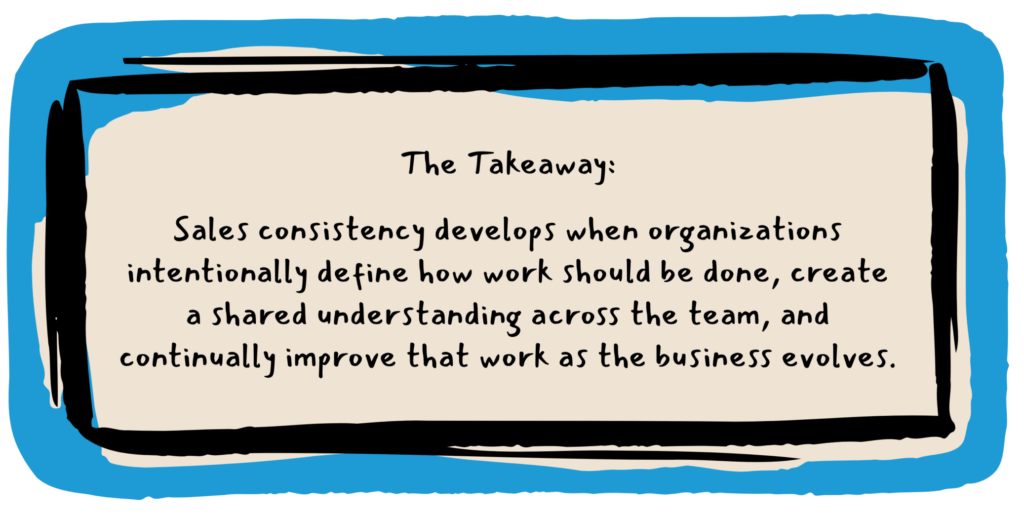
Sales consistency develops when organizations intentionally define how work should be done, create a shared understanding across the team, and continually improve that work as the business evolves.
Without that foundation, people naturally develop different ways of working. Then, forecasting becomes less reliable, and performance becomes harder to predict.
The strongest sales organizations create a way of working that can be learned, coached, measured, and continuously improved.
Questions Every Sales Leader Should Ask
Every sales organization develops its own way of working overtime.
The question is whether that way of working has been intentionally defined, consistently shared, and continually improved.
As you evaluate your sales organization, consider these questions:
- Do people share the same understanding of what defines a qualified opportunity?
- Is sales work performed consistently across the organization, or does it depend on the individual?
- Do managers coach against the same expectations?
- Can leadership confidently interpret sales performance and forecasts?
- When someone discovers a better way of working, does the entire team benefit?
- Does the organization have a consistent way to review and improve the sales process over time?
The answers reveal whether consistency is built into the way sales work is managed or dependent on the individuals doing the work.
Final Thoughts
Consistent sales performance doesn’t happen by accident.
It develops when organizations intentionally define how work should be done, create a shared understanding across the team, and continually improve that work overtime.
Sales Performance Diagnostic
If sales performance has become less predictable, it’s time to evaluate how sales work is being managed.
Most leaders don’t realize where consistency begins to break down until they step back and evaluate how sales work is actually being managed. That’s exactly what the Sales Performance Diagnostic is designed to help you do.
You’ll receive a personalized executive report with practical insights and recommendations to improve sales consistency, forecasting, and execution.