
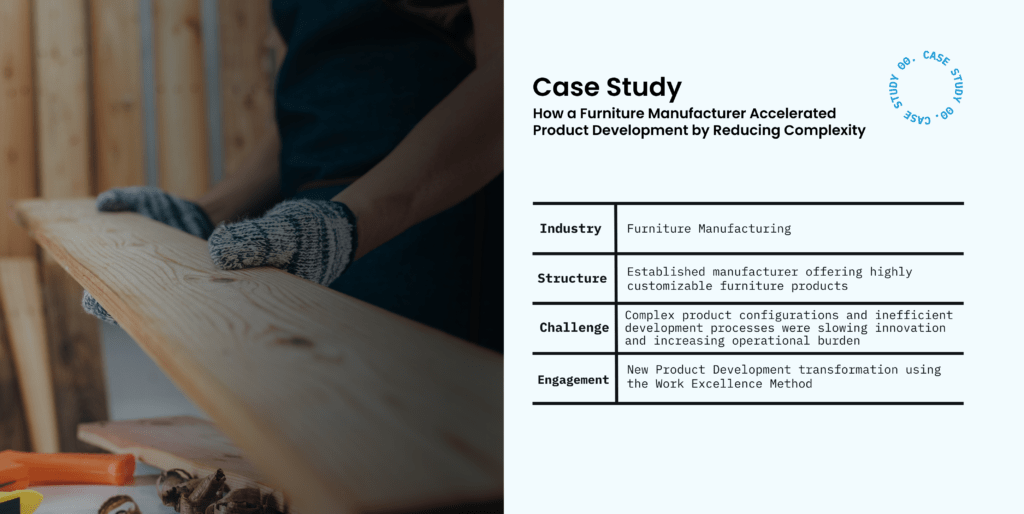
Challenge:
A leading furniture manufacturer had built its market position on offering customers extensive product customization.
However, the growing number of product combinations—including fabrics, cushions, frames, covers, and accessories—created significant complexity within the New Product Development (NPD) process.
However, the growing number of product combinations—including fabrics, cushions, frames, covers, and accessories—created significant complexity within the New Product Development (NPD) process.
This resulted in:
- Longer product development cycles
- Increased engineering complexity
- Higher levels of rework
- Slower response to market demand
- Reduced efficiency across manufacturing and development teams
The company needed a way to continue offering customization while improving speed, scalability, and operational performance.
Approach:
Work Excellence partnered with the organization to evaluate how work flowed throughout the product development process and identify barriers limiting speed and efficiency.
Rather than focusing solely on individual projects, the effort centered on improving how new products were designed, approved, and introduced across the business.
We worked directly on the business by:
- Mapping existing product development workflows
- Identifying bottlenecks and unnecessary complexity
- Evaluating the impact of customization on throughput and execution
- Creating a framework for balancing flexibility with operational efficiency
This created the foundation for a more scalable and disciplined product development system.
Solution
The organization redesigned its New Product Development process to improve execution, visibility, and speed.
This included:
1. Structured Development Stages
Phased development gates were introduced to improve accountability and accelerate decision-making.
2. Workflow Automation
Approval processes were automated, reducing delays and improving consistency.
3. Product Performance Visibility
A Product Performance Matrix was created to guide future development decisions using real-world results and performance data.
4. Complexity Reduction Through Standardization
Common components, materials, and product configurations were standardized where appropriate, reducing unnecessary complexity while maintaining customer choice.
5. Technology-Enabled Manufacturing
Technology integration improved material utilization, reduced setup time, and increased manufacturing efficiency.
Together, these changes enabled the organization to move new products through development faster while maintaining product flexibility and quality.
Results
The transformation delivered meaningful improvements across product development and operations:
✓
Reduced development time and associated costs
✓
Faster response to changing market demand and fewer rework incidents
✓
Improved material yield and manufacturing efficiency
✓
Stronger capacity planning through standardized processes and improved visibility
By improving how products moved from concept to production, the company increased its ability to innovate while maintaining operational discipline.
What This Means for Leaders
Growth in customization often creates growth in complexity.
Many organizations expand product offerings to meet customer demand, only to discover that complexity begins slowing execution, increasing costs, and reducing responsiveness.
This case demonstrates that innovation and efficiency do not have to compete. Organizations that intentionally manage complexity can improve both speed-to-market and operational performance.
Key Takeaways:

Product complexity can become a hidden barrier to growth and innovation

Standardization can improve speed and efficiency without eliminating customer choice

Strong development processes create capacity for future growth
Innovation and standardization are often viewed as competing priorities. In reality, they frequently reinforce one another.
Evaluating where complexity adds value and where it creates unnecessary friction reveals significant opportunities to improve speed, scalability, and performance.