
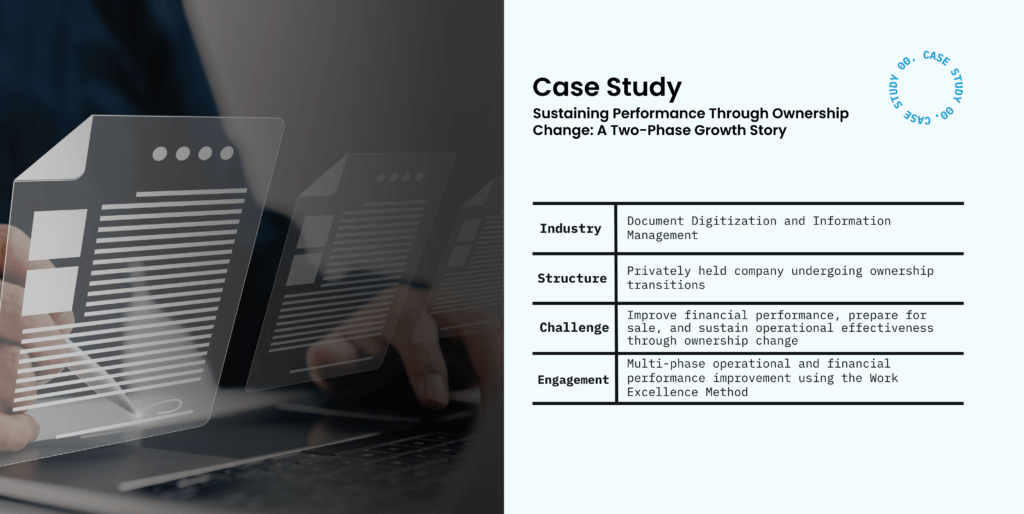
Challenge:
A document digitization company was preparing for a significant milestone in its growth journey.
Leadership’s initial objective was to improve EBITDA and strengthen operational performance in preparation for a potential sale. While progress was made, the business later entered a new phase following a change in ownership, creating a fresh set of expectations and financial targets.
Leadership’s initial objective was to improve EBITDA and strengthen operational performance in preparation for a potential sale. While progress was made, the business later entered a new phase following a change in ownership, creating a fresh set of expectations and financial targets.
Leadership’s initial objective was to improve EBITDA and strengthen operational performance in preparation for a potential sale. While progress was made, the business later entered a new phase following a change in ownership, creating a fresh set of expectations and financial targets.
This created several risks:
- Loss of organizational focus during transition periods
- Inconsistent execution across leadership teams
- Difficulty sustaining previous improvements
- Pressure to achieve new financial targets under new ownership
The company needed a system that could support performance regardless of who owned the business.
Approach:
Work Excellence partnered with leadership during two separate phases of the company’s evolution.
Rather than focusing on short-term financial improvements, the effort centered on creating a repeatable way of managing work, measuring performance, and driving accountability.
We worked directly on the business by:
- Developing operational systems that connected daily work to financial outcomes
- Training leaders to manage performance consistently
- Establishing clear visibility into operational and financial priorities
- Reinforcing disciplined execution across changing leadership environments
This approach created continuity during periods of significant organizational change.
Solution
The organization implemented a structured operating system designed to support both financial performance and long-term sustainability.
1. Leadership Capability Development
Leaders were trained to manage performance, prioritize improvements, and maintain accountability throughout the organization.
2. Integrated Work Systems
Operational systems were established to improve visibility, coordination, and execution across the business.
3. Performance Management Structure
Measures, routines, and review processes were introduced to support informed decision-making and continuous improvement.
4. Organizational Continuity
The methodology became embedded within leadership practices, allowing improvements to continue through ownership and leadership transitions.
Together, these changes created a foundation for sustainable performance beyond any single leader or ownership group.
Results
The transformation delivered measurable business outcomes across both phases of the company’s evolution:
✓
Successfully positioned the company for sale
✓
Achieved EBITDA targets during both ownership periods
✓
Maintained operational performance through leadership and ownership transitions
✓
Established a foundation for continued growth under new ownership
By embedding performance systems into the business, the organization was able to maintain momentum and continue delivering results despite significant change.
What This Means for Leaders
Sustainable performance should not depend on a single leader, owner, or moment in time.
Many organizations improve results through focused initiatives, only to see progress fade during leadership transitions, ownership changes, or shifts in strategy. Without systems that support continuity, performance often becomes difficult to sustain.
This case demonstrates that long-term success comes from building operating systems that outlast organizational change.
Key Takeaways:
Ownership transitions can expose weaknesses in how performance is managed
Sustainable growth requires systems that survive changes in leadership
Organizational capability is built when methods become embedded in daily operations
Business continuity depends on how effectively knowledge, accountability, and execution are built into how the organization works.
Evaluating whether performance depends on individuals or on systems can reveal significant opportunities to strengthen long-term growth and resilience.