
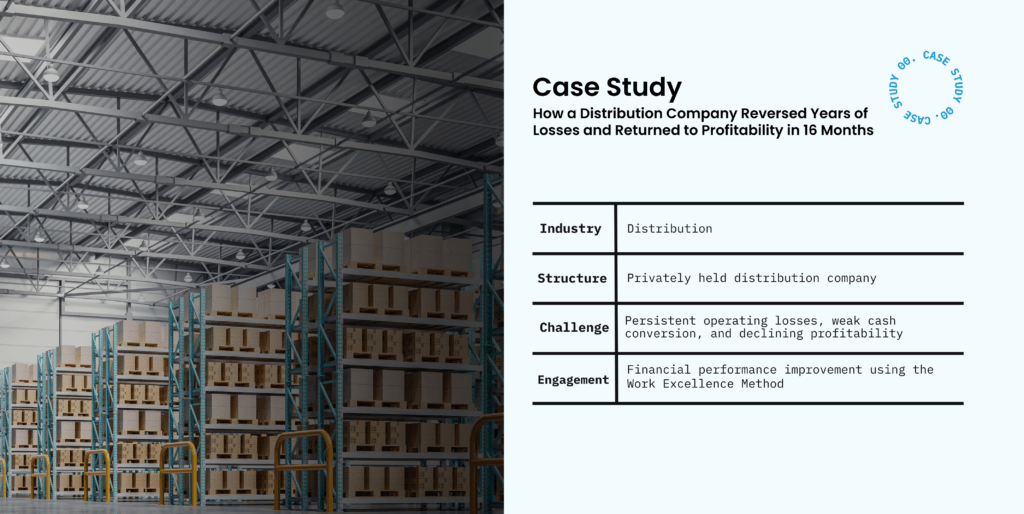
Challenge:
A distribution company had been operating at a loss for several years, sustaining approximately $1 million in annual deficits.
While revenue continued to flow through the business, financial performance remained weak. Leadership lacked visibility into several key drivers impacting profitability, including cash conversion, gross margin performance, and operational spending.
This resulted in:
- Ongoing operating losses
- Cash flow constraints
- Limited financial flexibility
- Inefficient spending patterns
- Difficulty translating revenue into profitability
The organization needed a clearer understanding of the financial levers influencing performance and a structured approach to improving them.
Approach:
Work Excellence partnered with leadership to evaluate the underlying drivers affecting financial performance.
Rather than focusing solely on cost reduction, the work centered on improving how financial decisions were made and managed across the business.
We worked directly on the business by:
- Assessing cash conversion, margin performance, and operating expenses
- Identifying opportunities to improve profitability and liquidity
- Building organizational understanding of key financial measures
- Aligning leadership around a structured plan for financial improvement rational efficiency
This created a shared framework for evaluating decisions through the lens of profitability and long-term performance.
Solution
The organization implemented a financial improvement system designed to strengthen visibility, accountability, and decision-making. This included:
1. Financial Performance Education
Workshops and coaching helped leaders better understand the drivers of profitability and cash flow.
2. Cross-Functional Financial Accountability
Teams worked together to align operational decisions with financial objectives.
3. Margin Improvement Initiatives
Strategies were developed to improve gross margin performance while reducing unnecessary costs.
4. Cash Flow Management
Processes were strengthened to improve cash conversion and increase financial flexibility.
Together, these efforts created a more disciplined approach to managing profitability across the organization.
Results
The transformation delivered significant financial improvements:
✓
Returned to positive EBITDA in less than 16 months
✓
Improved gross profit margin from 1% to 8%
✓
Reduced unnecessary operating costs
✓
Improved cash conversion and liquidity
By improving how financial decisions were evaluated and managed, the company successfully transitioned from years of losses to sustainable profitability.
What This Means for Leaders
Financial performance is often shaped long before results appear on an income statement.
Organizations frequently focus on revenue growth while overlooking the operational and financial decisions that ultimately determine profitability. Without visibility into margins, cash flow, and spending patterns, even growing businesses can struggle financially.
This case demonstrates that improving profitability requires more than cost-cutting. It requires understanding and actively managing the financial drivers of performance.
Key Takeaways:

Revenue growth does not automatically translate into profitability

Financial visibility enables better operational and strategic decisions
Sustainable profitability comes from disciplined management of margins, cash flow, and expenses
Profitability is a function of how consistently financial decisions are made throughout the business.
Evaluating the systems, measures, and behaviors that influence cash flow and margins can reveal significant opportunities to improve long-term financial performance.