
Challenge:
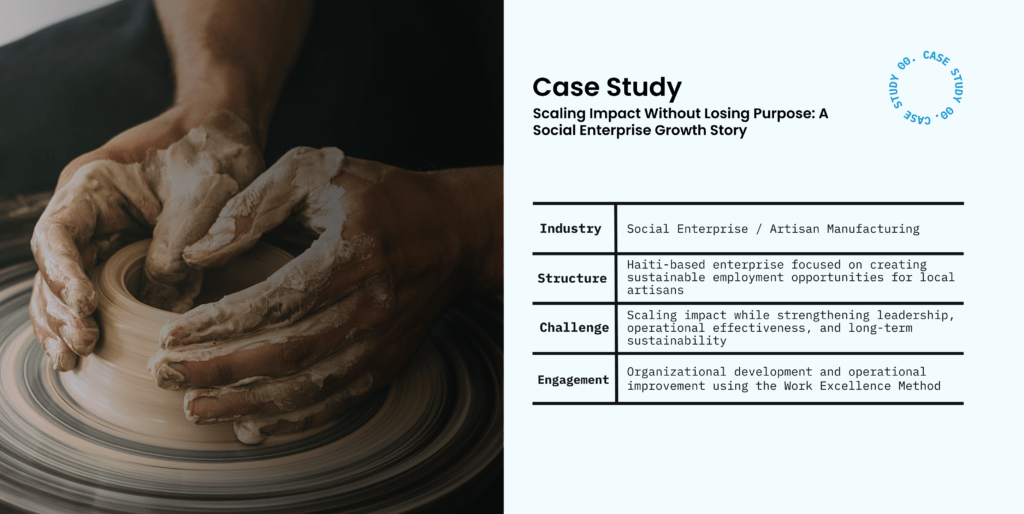
A purpose-driven enterprise in Haiti had built a successful model centered on creating sustainable employment opportunities for local artisans.
The organization’s mission extended beyond economic development. By creating stable jobs, it helped families remain together and strengthened local communities.
The organization’s mission extended beyond economic development. By creating stable jobs, it helped families remain together and strengthened local communities.
Several priorities emerged:
- Expanding employment opportunities for artisans
- Developing local leadership capability
- Improving operational consistency
- Strengthening the organization’s ability to communicate its value and impact
The founder had built an organization supporting more than 500 artisans but needed a stronger operating foundation to support future growth.
Approach:
Work Excellence partnered directly with the founder and leadership team to strengthen how the organization managed work, developed leaders, and executed its mission.
Rather than focusing solely on operational improvements, the work centered on aligning day-to-day activities with long-term impact objectives.
We worked directly on the business by:
- Assessing operational workflows and leadership practices
- Facilitating workshops focused on organizational priorities and execution
- Establishing more consistent leadership routines
- Creating greater alignment between mission, strategy, and operations
This approach helped ensure growth efforts remained connected to the organization’s core purpose.
Solution
The organization implemented a more structured operating model designed to support both mission delivery and sustainable growth.
1. Leadership Development
Coaching and workshops helped build leadership capability while preparing local team members to assume greater responsibility throughout the organization.
2. Operational Clarity
Workflows and management routines were clarified to improve consistency, accountability, and execution.
3. Mission-Aligned Execution
The organization strengthened the connection between strategic priorities and daily operations, improving focus across teams.
4. Impact Communication
Clearer value propositions and messaging improved the organization’s ability to communicate results, engage partners, and support future growth opportunities.
Together, these improvements created a stronger foundation for long-term impact.
Results
The transformation delivered meaningful organizational and social outcomes:
✓
Increased artisan employment from 500 to more than 800 individuals within three years
✓
Strengthened local leadership through successful transitions of key operational responsibilities
✓
Enhanced the organization’s ability to attract partners and communicate impact
✓
Expanded capacity to deliver on its mission while maintaining long-term sustainability
By improving how work was structured and managed, the organization increased both its reach and its impact.
What This Means for Leaders
Purpose creates direction, but systems create the capacity to scale it.
Many mission-driven organizations reach a point where passion and commitment alone are no longer enough to support growth. As impact expands, leaders must build the structures, routines, and leadership capability needed to sustain it.
This case demonstrates that scaling impact is not about choosing between mission and operational excellence—it is about using operational excellence to amplify mission.
Key Takeaways:
Growth requires systems that support consistent execution
Leadership development is essential for long-term sustainability
Clear operational structures help organizations scale impact without losing focus
One of the most difficult leadership challenges is scaling an organization without losing its purpose.
Organizations that intentionally strengthen these connections are often better positioned to grow their impact while remaining true to their purpose.