
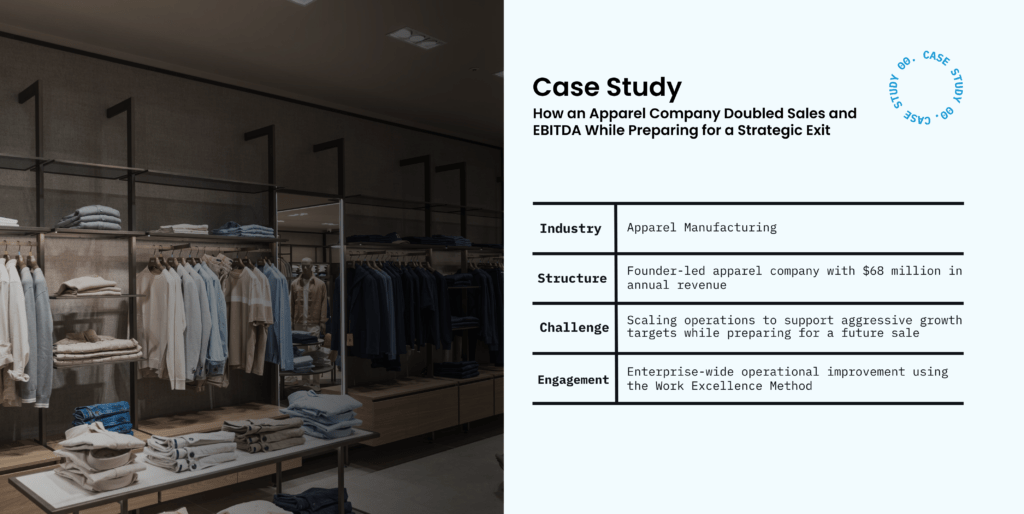
Challenge:
What began as a small business had grown into a $68 million apparel company with ambitious goals.
Leadership set a clear objective: double sales and EBITDA within five years while preparing the organization for a potential future sale.
Leadership set a clear objective: double sales and EBITDA within five years while preparing the organization for a potential future sale.
Key challenges included:
- Scaling operations without increasing inefficiencies
- Improving workforce stability in production environments
- Strengthening inventory and supply chain performance
- Building the operational discipline required to support long-term growth and enterprise value
The organization needed a scalable operating model capable of supporting both growth and future ownership transitions.
Approach:
Work Excellence partnered with leadership to evaluate how work was managed across the business and identify opportunities to strengthen operational performance.
Rather than focusing on isolated improvements, the effort centered on building the systems and capabilities necessary to support long-term growth.
We worked directly on the business by:
- Assessing operations across manufacturing, supply chain, HR, and strategic planning
- Identifying barriers to scalability and growth
- Aligning operational priorities with long-term business objectives
- Building greater consistency in how work was managed across departments
This created a foundation for sustainable growth while improving readiness for future strategic opportunities.
Solution
The organization implemented a series of improvements designed to strengthen operational performance and support growth objectives.
1. Supply Chain and Inventory Optimization
Inventory management systems and production scheduling processes were improved to reduce shortages, improve responsiveness, and support more efficient operations.
2. Workforce Development
Recruitment and hiring practices were redesigned to better align with company culture and long-term workforce needs.
3. Employee Engagement and Retention
Structured onboarding, training, and job rotation programs improved employee development and engagement throughout production operations.
4. Growth-Focused Operational Management
Operational improvements were aligned directly with strategic growth goals, ensuring execution supported both financial performance and long-term value creation.
Together, these changes created a stronger operating foundation capable of supporting continued expansion.
Results
The transformation delivered significant business and operational outcomes:
✓
Doubled sales and EBITDA within the targeted five-year period
✓
Improved employee retention and satisfaction across production teams
✓
Established a scalable operating model to support future growth
✓
Successfully positioned the company for a strategic sale completed in 2019, with founders retaining partial ownership
The organization not only achieved its growth objectives but also increased enterprise value and created greater flexibility for the future.
What This Means for Leaders
Growth alone does not create enterprise value—scalability does.
Many organizations focus on increasing revenue while overlooking the systems required to support sustainable growth. As companies expand, weaknesses in operations, workforce development, and execution often become barriers to performance.
This case demonstrates that preparing for future growth, or a future exit, requires building an operating model capable of consistently delivering results.
Key Takeaways:
Sustainable growth requires operational systems that can scale with the business
Workforce stability and operational discipline directly impact enterprise value
Exit readiness is often the result of years of intentional operational improvement
A business becomes more valuable when success depends less on individuals and more on systems.
Evaluating whether your systems, processes, and people are prepared to support future growth can reveal significant opportunities to improve both performance and long-term business value.