
Challenge:
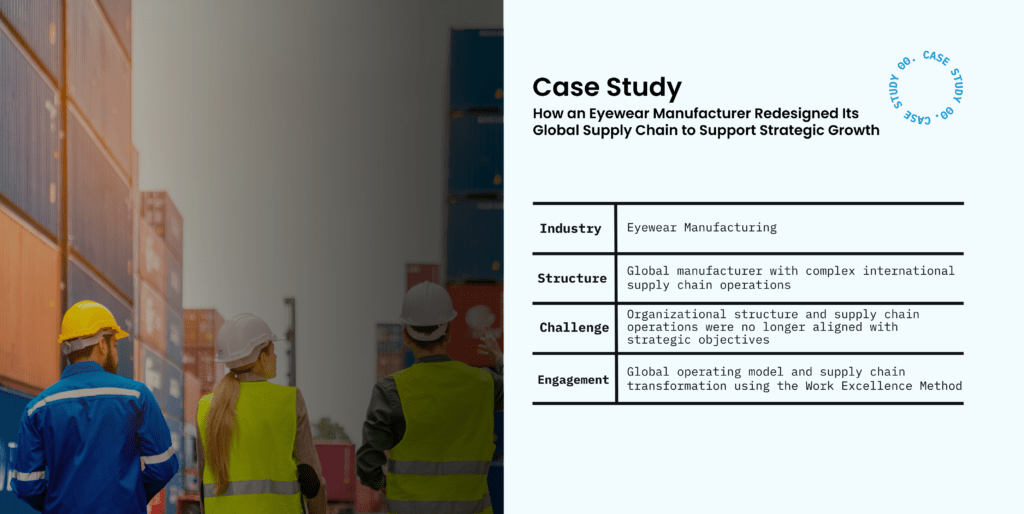
A global eyewear manufacturer had built a strong market presence but was experiencing increasing disconnects between its supply chain operations, organizational structure, and long-term business strategy.
As the company expanded, inefficiencies within the supply chain made it more difficult to execute consistently across regions. Roles and responsibilities were not always clearly defined, communication between functions was fragmented, and operational decisions were not consistently aligned with strategic priorities.
This resulted in:
- Reduced visibility across global operations
- Inconsistent accountability across functions
- Communication barriers between regional teams
- Supply chain processes that no longer supported the company’s evolving strategy d
Leadership recognized that improving performance would require more than process improvements—it would require rethinking how the supply chain and organization were structured to operate.
Approach:
Work Excellence partnered with leadership to evaluate how work flowed throughout the global supply chain and identify barriers preventing effective execution.
Rather than focusing on isolated process improvements, the initiative centered on redesigning the operating model to better support strategic objectives.
We worked directly on the business by:
- Establishing a global cross-functional team to assess current workflows and operating structures
- Evaluating how organizational design supported (or hindered) execution
- Facilitating strategic discussions between leadership and operational teams across regions
- Applying the Work Excellence Method to redesign the supply chain work system
This approach created a shared understanding of both operational challenges and future-state requirements.
Solution
The organization implemented a redesigned global operating model that improved both supply chain performance and organizational effectiveness.
1. Redesigned Supply Chain Workflows
Processes were mapped and restructured to better support strategic goals and improve execution across regions.
2. Clarified Organizational Structure
Roles, responsibilities, and reporting relationships were clearly defined to improve accountability and decision-making.
3. Improved Cross-Functional Connectivity
Operational silos were reduced through greater transparency and collaboration between teams and regions.
4. Performance Visibility
Systems were introduced to track performance metrics and cost drivers, creating greater visibility into operational performance and improvement opportunities.
Results
The transformation delivered meaningful improvements across both operations and leadership.
✓
Increased workflow clarity and accountability through clearly defined roles and responsibilities
✓
Stronger collaboration between multinational and cross-functional teams
✓
Cost savings and performance improvements driven by greater operational efficiency
✓
Organizational structure successfully aligned with the company’s strategic direction
By redesigning how work was structured and managed, the company created a supply chain capable of supporting future growth and continued global expansion.
What This Means for Leaders
Growth can expose gaps between business strategy and operational reality.
As organizations evolve, operating models that once supported success can become barriers to execution. When workflows, structures, and responsibilities are no longer aligned with strategic priorities, performance suffers and complexity increases.
This case demonstrates that improving supply chain performance is not simply about optimizing processes—it is about ensuring the entire operating model supports where the business is trying to go.
Key Takeaways:
Supply chain performance is heavily influenced by organizational design
Growth often requires rethinking how work is structured and managed
Clear accountability improves both execution and decision-making
As organizations grow, leaders should periodically ask a simple question: Does our operating model still support our strategy?
Taking time to evaluate whether your operating model still supports your business objectives can reveal significant opportunities for improvement and growth.