
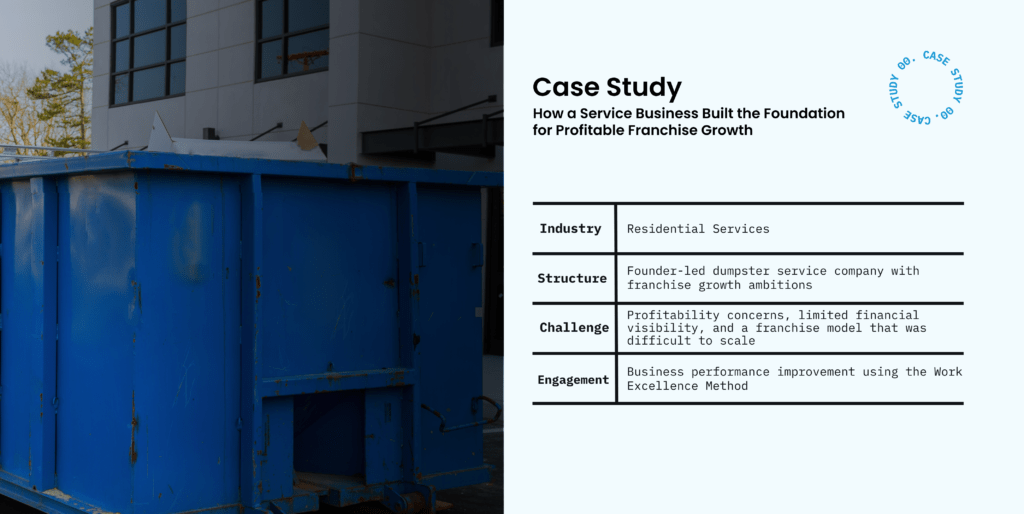
Challenge:
A residential-focused dumpster service company had developed a unique market offering supported by patented technology and strong customer demand.
Despite generating approximately $1 million in annual revenue, growth had begun to plateau. Leadership faced increasing concerns around profitability, financial visibility, and the long-term viability of its franchise expansion strategy.
Several challenges were limiting progress:
- Limited visibility into the true drivers of profitability
- Difficulty separating franchise performance from operating performance
- Inconsistent systems to support scalable growth
- Lack of clear alignment between employee performance and business outcomes
The company needed a more structured approach to managing performance before it could confidently pursue additional growth.
Approach:
Work Excellence partnered directly with the owner to improve how financial and operational decisions were made across the business.
Rather than focusing solely on revenue growth, the effort centered on creating the systems and visibility required to support profitable expansion.
We worked directly on the business by:
- Evaluating financial performance across operating and franchise activities
- Identifying key measures influencing profitability
- Building leadership capability around performance management
- Creating greater alignment between employee actions and business objectives
This created a stronger foundation for both operational performance and future franchise growth.
Solution
The organization implemented a more disciplined operating model designed to improve profitability and scalability.
1. Financial Visibility
Financial reporting was refined to create clearer separation between operating activities and franchise performance, improving decision-making and accountability.
2. Performance Management
Key performance measures were established to provide greater visibility into business performance and growth opportunities.
3. Leadership Development
Workshops and coaching helped leaders establish consistent routines, goals, and management practices.
4. Incentive Alignment
A performance-based bonus structure was introduced to better connect employee actions with financial outcomes.
5. Franchise Model Refinement
The franchise structure was updated to support more consistent and profitable growth across future locations.
Together, these improvements created a stronger foundation for scaling the business.
Results
The transformation delivered meaningful operational and financial improvements:
✓
Increased profitability and improved readiness for future growth or sale
✓
Greater visibility into the financial drivers of performance
✓
Improved operational efficiency and margin performance
✓
A more scalable and sustainable franchise model
By improving how performance was measured and managed, the company positioned itself for long-term growth while strengthening profitability.
What This Means for Leaders
Growth becomes difficult to sustain when systems fail to scale alongside the business.
Many organizations reach a point where entrepreneurial success alone is no longer enough. As growth opportunities increase, weaknesses in financial visibility, operational discipline, and performance management often become more apparent.
This case demonstrates that scaling successfully requires more than a great product or service—it requires a business model capable of consistently delivering results.
Key Takeaways:

Financial visibility is essential for identifying opportunities to improve profitability

Growth initiatives are more effective when supported by clear operating systems

Incentives and performance measures should reinforce desired business outcomes
Scalable growth happens when systems, people, and performance measures work together.
Evaluating whether your current operating model can support future growth may reveal opportunities to improve profitability, consistency, and long-term business value.