
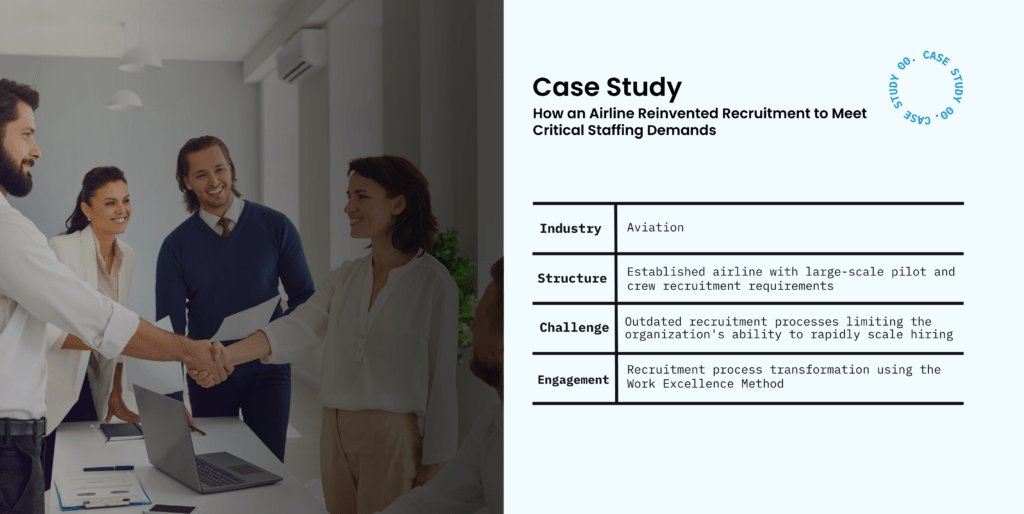
Challenge:
During a period of global disruption, an established airline faced an urgent workforce challenge.
The organization needed to significantly increase hiring for pilots and crew members within a compressed timeframe. However, existing recruitment processes were not designed to support the speed and scale required.
The HR team faced several obstacles:
- Manual and inefficient hiring workflows
- Recruitment delays and process errors
- Limited coordination across teams involved in hiring
- Increasing pressure to meet critical staffing requirements
Without a new approach, the organization risked falling short of workforce needs at a time when staffing capacity directly impacted operational performance.
Approach:
Work Excellence partnered with HR leadership to improve how recruitment activities were organized, managed, and executed.
Rather than focusing solely on hiring volume, the work centered on improving the organization’s ability to coordinate and execute hiring efforts under pressure.
We worked directly on the business by:
- Evaluating existing recruitment workflows and identifying bottlenecks
- Facilitating leadership workshops to align priorities and decision-making
- Improving collaboration across functions involved in the hiring process
- Establishing more structured and scalable recruitment routines
This created a foundation for both immediate hiring success and long-term workforce planning capability.
Solution
The organization implemented a more agile and coordinated recruitment system designed to support rapid scaling.
This enabled:
1. Cross-Functional Collaboration
Leaders from across the HR function worked together to design and implement solutions, improving coordination and accountability.
2. Streamlined Hiring Workflows
Recruitment processes were redesigned to reduce delays and improve consistency while integrating with existing systems.
3. Continuous Improvement and Support
Ongoing coaching helped teams sustain momentum, refine processes, and adapt to changing hiring demands.
Together, these changes improved the organization’s ability to respond quickly while maintaining quality and consistency.
Results
The transformation delivered measurable improvements across recruitment operations:
✓
Successfully achieved hiring objectives within six months
✓
Reduced recruitment errors and process delays
✓
Improved hiring speed and operational responsiveness
✓
Created more scalable recruitment processes capable of supporting future growth
✓
Established a stronger culture of collaboration and innovation across HR teams
The organization not only met its immediate staffing goals but also built a stronger foundation for future workforce planning and execution.
What This Means for Leaders
The ability to scale quickly is often determined by how effectively work can be coordinated across teams.
When organizations face sudden shifts in demand, existing processes can quickly become constraints. Teams that rely on disconnected workflows and informal coordination often struggle to respond at the pace required.
This case demonstrates that improving agility starts with improving how work is organized, communicated, and executed across the organization.
Key Takeaways:
Workforce challenges often reveal broader process and coordination issues
Cross-functional collaboration is critical when speed and scale are required
Structured workflows create the flexibility needed to adapt during periods of change
High-performing organizations share a common trait: they can adapt without losing momentum.
Taking time to evaluate how work moves across functions can uncover opportunities to improve responsiveness, scalability, and overall performance.