
Challenge:
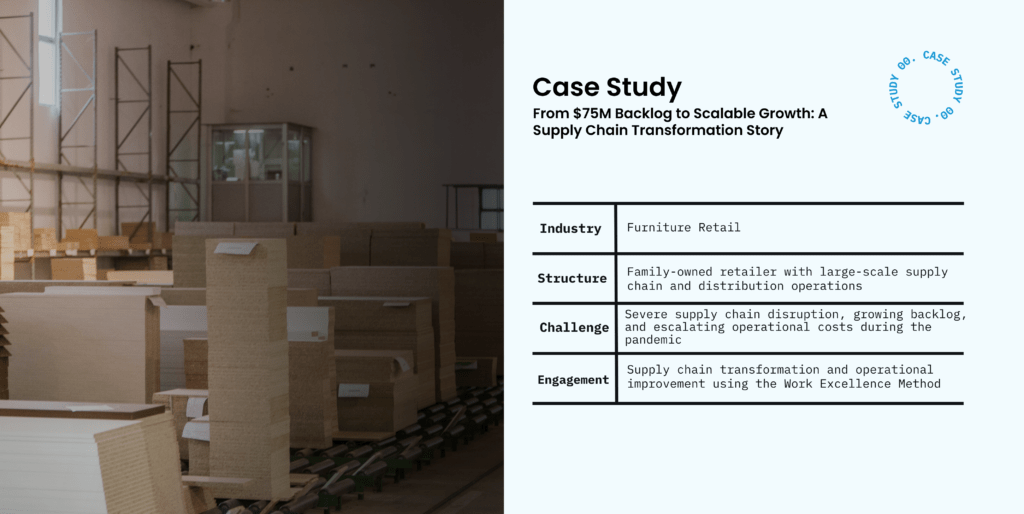
Like many retailers during the pandemic, this family-owned furniture company faced unprecedented disruption across its supply chain.
Rapid shifts in demand created a significant bullwhip effect, resulting in a backlog exceeding $75 million. At the same time, container costs surged from approximately $4,000 to $32,000, placing enormous pressure on inventory management, operational capacity, and profitability.
Leadership faced several critical challenges:
- Limited visibility into rapidly changing supply chain conditions
- Growing inventory and fulfillment pressures
- Rising distribution and transportation costs
- Difficulty aligning labor and resources with fluctuating demand
The company needed a structured approach to regain control and build a more resilient operating model.
Approach:
Work Excellence partnered with supply chain leadership to improve how performance was measured, managed, and executed across the organization.
Rather than focusing on isolated operational fixes, the initiative centered on creating greater visibility into performance and establishing disciplined execution routines.
We worked directly on the business by:
- Training leaders to improve operational decision-making and accountability
- Developing structured improvement plans across key areas of the supply chain
- Establishing consistent work rhythms and review processes
- Building measurement systems to support ongoing performance management
This created a shared framework for identifying issues, prioritizing actions, and tracking progress.
Solution
The organization implemented a comprehensive performance management system designed to improve visibility and operational control. This included:
1. Advanced Supply Chain Analytics
New analytics capabilities provided real-time visibility into key operational metrics and performance trends.
2. Enhanced Work Measurement
Base and management models were developed to improve the organization’s ability to track performance and identify exceptions.
3. Performance Dashboards
Integrated dashboards enabled leaders to monitor critical measures and make faster, more informed decisions.
4. Capacity Alignment
Labor planning was aligned with revenue and operational demand, improving resource utilization while supporting future growth.
Together, these improvements created a more disciplined and data-driven approach to managing supply chain performance.
Results
The transformation delivered significant operational and financial improvements:
✓
Reduced backlog below historical levels within 14 months
✓
Cut inventory by $11 million within eight months
✓
Reduced distribution center costs by 5% in 2022, with additional reductions projected
✓
Improved labor-to-revenue alignment, creating capacity for growth
✓
Completed six of eight strategic improvement plans
✓
Increased performance visibility through enhanced analytics and exception management
By improving how work was measured and managed, the company transformed a period of significant disruption into an opportunity to strengthen its operations and position itself for future growth.
What This Means for Leaders
Periods of disruption often expose weaknesses that already exist within an operating system.
When visibility is limited and decision-making is reactive, volatility quickly turns into backlogs, rising costs, and operational strain. Organizations that can clearly measure performance and respond to exceptions are better positioned to adapt when conditions change.
This case demonstrates that resilience is not built during a crisis—it is built through the systems used to manage work before, during, and after disruption.
Key Takeaways:
Visibility is essential for managing volatility and uncertainty
Performance measurement enables faster and more effective decision making
Structured operating routines create resilience during periods of disruption
Organizational resilience is a function of how effectively performance is measured and managed.
Evaluating how information flows through the business and how leaders respond to changing conditions can uncover significant opportunities to improve both performance and adaptability.