
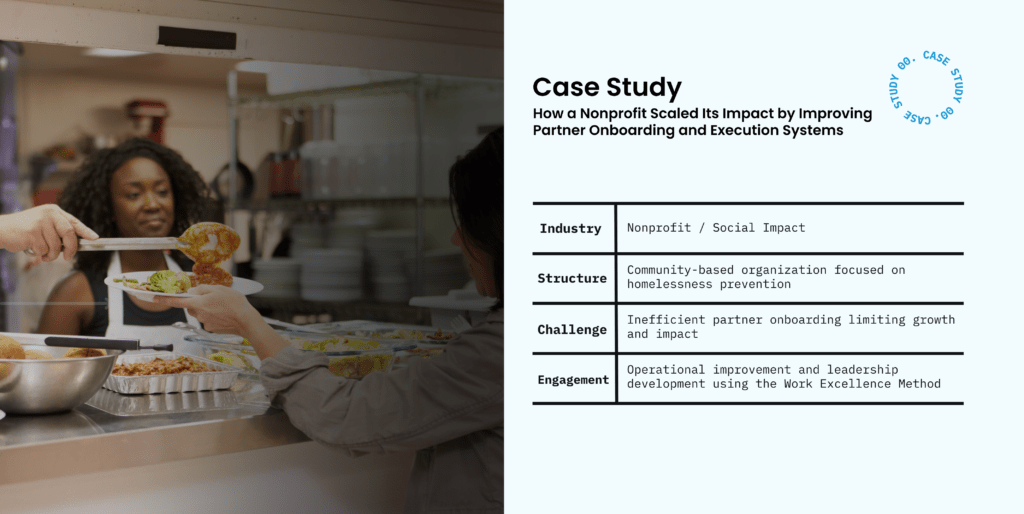
Challenge:
A nonprofit organization focused on preventing homelessness relied heavily on partnerships with community organizations to identify and support at-risk individuals.
However, their ability to scale impact was constrained by an inefficient onboarding process for new partners.
However, their ability to scale impact was constrained by an inefficient onboarding process for new partners.
This resulted in:
- Slower expansion of community partnerships
- Missed opportunities for early intervention
- Increased strain on existing systems
- Reduced overall impact
While the mission was clear, the organization lacked a structured way to efficiently bring new partners into its network and scale its operations.
Approach:
Work Excellence partnered with leadership and board members to improve how the organization executed its strategy, starting with partner onboarding.
Rather than focusing only on process improvements, the work centered on improving how work was structured, managed, and scaled.
We worked directly on the business by:
- Clarifying and redesigning the partner onboarding process
- Establishing structured workflows to improve execution consistency
- Strengthening leadership decision-making and operational clarity
Through workshops and ongoing engagement, the organization built a more disciplined and scalable way of operating.
Solution:
The organization implemented a structured onboarding and operational system that improved both efficiency and scalability.
This enabled:
1. Streamlined Partner Onboarding
Clear steps and workflows allowed new partners to be integrated more quickly and consistently.
2. Improved Workflow Visibility
Teams gained clarity into how work progressed, making it easier to identify delays and improve performance.
3. Scalable Operational Structure
Work systems were expanded beyond onboarding to support broader organizational growth and execution.
With improved structure and clarity, leadership was able to align the organization around a more effective strategy for scaling impact.
Results
The improvements in execution translated directly into measurable social impact:
700+ instances of homelessness prevented within 18 months

Faster partner onboarding, enabling expanded community reach
Improved leadership decision-making, supporting more effective strategy execution
Stronger partner relationships, increasing collaboration and satisfaction
What This Means for Leaders
Mission impact is often limited not by intent, but by how effectively the organization operates.
When key processes like onboarding are inefficient, they become bottlenecks that restrict growth, reduce reach, and limit overall impact.
This case shows that scaling impact requires more than strategy, it requires improving how work is structured and executed across the organization.
Key Takeaways:
✓
Operational bottlenecks can significantly limit an organization’s ability to scale impact
✓
Inefficient processes reduce both reach and effectiveness, even with strong mission alignment
✓
Improving execution systems enables organizations to expand impact without increasing complexity
Impact at scale is often a function of how effectively key processes are structured and executed.
Evaluating where work slows down—and how core processes like onboarding are managed—is often where the greatest opportunities for growth and impact can be found.