
Challenge:
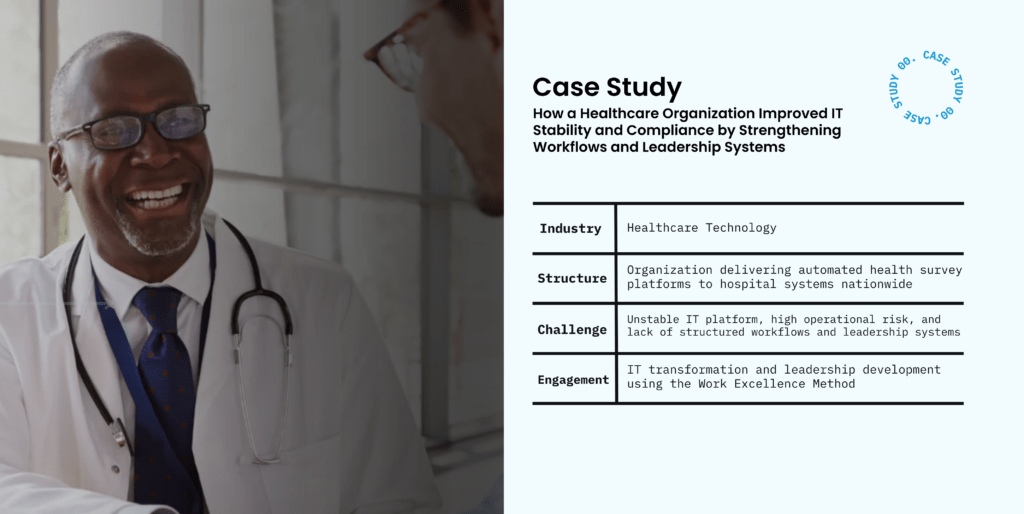
A healthcare organization providing automated health survey platforms to hospital systems nationwide was facing critical instability within its IT environment.
The platform—essential to delivering services—was:
- Unstable
- Insecure
- Difficult to scale
- At risk of compliance issues
Operational problems were frequent, and the lack of structured workflows made it difficult to consistently identify and resolve issues.
At the same time, leadership recognized that long-term improvement would require more than technical fixes. The organization lacked:
- Clear workflows for managing IT operations
- Consistent routines for identifying and addressing issues
- Leadership systems to sustain performance and accountability
Without these, the organization faced ongoing risk to both its operations and its clients.
Approach:
Work Excellence partnered with the organization to improve how IT work was structured, managed, and led.
Rather than focusing only on technical fixes, the work centered on improving workflow clarity, operational routines, and leadership capability.
We worked directly on the business by:
- Training leadership teams to establish consistent ways of managing work and making decisions
- Defining structured workflows to improve how services were delivered
- Introducing regular review routines to create visibility into issues and drive continuous improvement
This created a foundation for both immediate stabilization and long-term scalability.
Solution:
The organization implemented a structured operating system for IT delivery, improving both execution and accountability.
This enabled:
1. Clear Workflows and Responsibilities
Teams gained clarity on how work flowed and who was responsible at each stage.
2. Consistent Operational Routines
Regular review processes ensured issues were identified, discussed, and resolved quickly.
3. Knowledge and Process Standardization
Best practices and standard work were documented, improving consistency and reducing variability.
As stability improved, the organization was able to shift focus toward enhancing compliance and scaling operations.
Results
The transformation delivered meaningful improvements in both performance and risk reduction:
Operational issues reduced from 135 incidents to sustained periods with zero new issues
Improved platform stability, security, scalability, and reliability
Stronger compliance performance, reducing regulatory risk
Improved leadership capability, with clearer roles and increased accountability
What This Means for Leaders
Technical instability is often a symptom, not the root cause.
When teams lack clear workflows and consistent ways of managing issues, problems accumulate, increasing risk and making systems harder to stabilize.
This case highlights that lasting improvements in stability and compliance come from strengthening how work is managed day to day, not just addressing technical defects.
Key Takeaways:
✓
Operational instability often stems from unclear workflows and inconsistent routines
✓
Technical issues are harder to resolve without visibility into how work is managed
✓
Strengthening leadership systems is critical for sustaining performance and compliance
System reliability is often a function of how clearly workflows and operational routines are defined and managed.
Evaluating how work is structured—and how issues are surfaced and addressed—is often where the greatest improvements in stability and risk reduction can be achieved.