
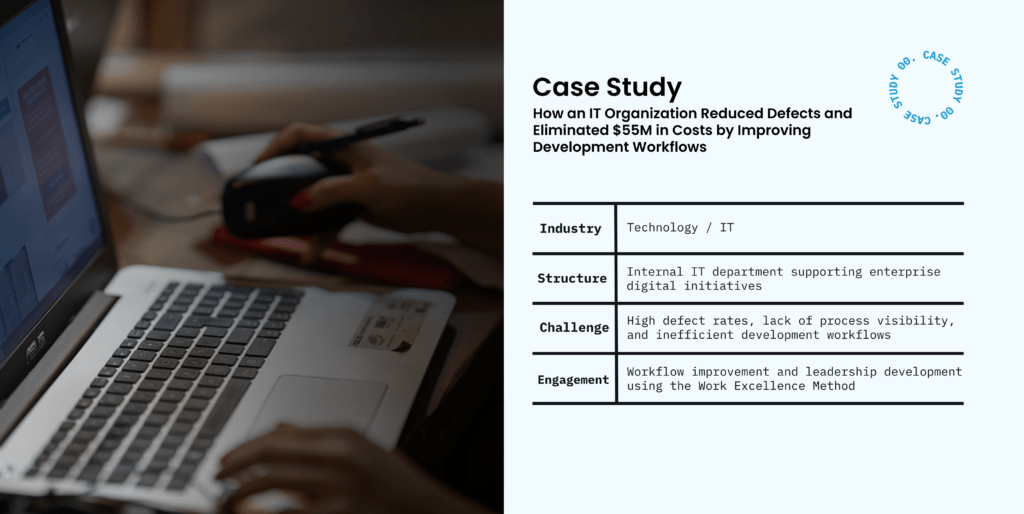
Challenge:
A large IT department responsible for supporting digital initiatives was experiencing a 50% defect rate in code production, significantly slowing progress and increasing costs.
The team lacked clear visibility into how work moved through the development process. Without a structured system for managing workflows and identifying issues, defects were often discovered late, leading to rework and delays.
This resulted in:
- Slower delivery timelines
- High reliance on external contractors
- Increased operational costs
- Frustration across teams due to recurring quality issues
Despite strong technical talent, the absence of clear workflows and visibility made it difficult to consistently deliver high-quality output.
Approach:
Work Excellence partnered with leadership to improve how development work was structured, managed, and executed.
Rather than focusing solely on technical fixes, the work centered on improving workflow visibility, problem-solving, and leadership capability.
We worked directly on the business by:
- Creating visual systems to make development workflows and issues visible in real time
- Coaching leadership to establish clearer processes and improve decision-making
- Introducing structured problem-solving to identify and address root causes of defects
This approach allowed the team to move from reactive issue resolution to proactive workflow management and continuous improvement.
Solution:
The organization implemented a visual and structured workflow management system that improved both execution and collaboration.
This enabled:
1. Real-Time Workflow Visibility
Teams could clearly see how work progressed, where issues occurred, and how defects were introduced.
2. Faster Problem Identification and Resolution
Defects and inefficiencies were identified earlier, reducing rework and delays.
3. Improved Collaboration and Ownership
Teams worked more cohesively, with greater accountability for quality and outcomes.
Leadership also strengthened development processes by incorporating external expertise where needed, further improving code quality and consistency.
Results
The impact on quality, cost, and execution was substantial:

Significant reduction in defect rates, improving code quality and reliability

$55M saved over 5 years through reduced rework and contractor reliance

Reduced contractor dependence by strengthening internal capabilities

Improved execution speed and collaboration across development teams
What This Means for Leaders
Quality issues reflect how work is structured and managed.
When teams lack visibility into workflows and a clear process for identifying issues, defects increase; rework compounds, and costs rise, even with strong talent in place.
This case shows that improving quality and reducing costs starts with improving how work flows and how problems are identified and solved.
Key Takeaways:
✓
Defects increase when workflows lack visibility and structure
✓
Rework and cost overruns are often driven by late issue detection
✓
Improving how work is managed leads to both quality and cost improvements
Execution quality is a function of how clearly workflows are defined and managed.
Evaluating how work flows through your teams—and where issues are identified—is often where the greatest improvements in quality and cost can be achieved.