
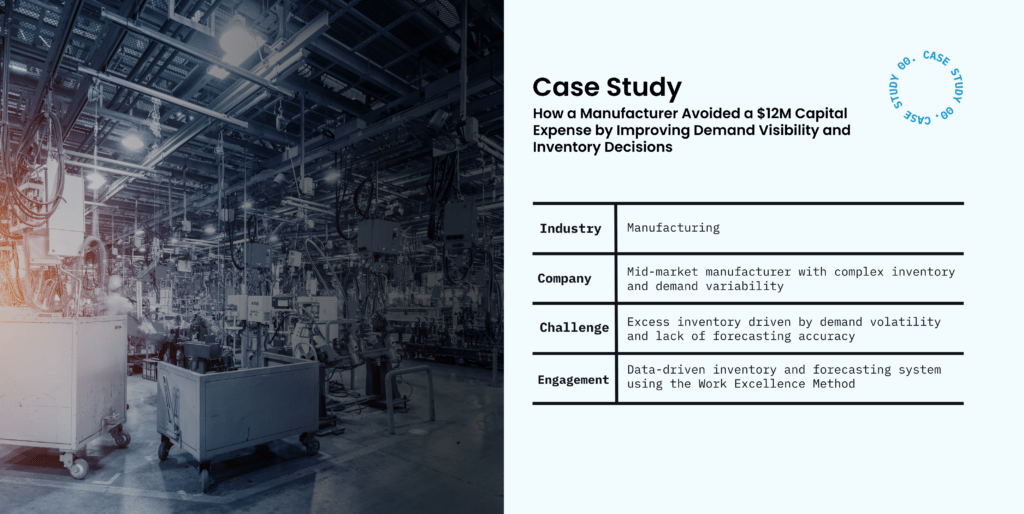
Challenge:
A manufacturer was experiencing significant inventory challenges driven by pandemic-related demand volatility. Fluctuations in customer demand created a bullwhip effect, leading to overproduction and a warehouse filled with slow-moving inventory. As a result, large amounts of cash were tied up in excess stock, limiting the company’s financial flexibility.
At the same time, leadership lacked clear visibility into actual demand patterns, making it difficult to confidently adjust production and ordering decisions. Without a reliable system for forecasting and inventory management, the organization was operating reactively, continuously adjusting after issues had already occurred.
Approach:
Work Excellence partnered with the organization to improve how inventory decisions were made by focusing on demand visibility and forecasting accuracy. Rather than relying on historical data distorted by irregular buying behavior, the team shifted the focus to customer-driven demand signals.
We worked directly on the business by:
- Redefining how demand data was used to inform production and inventory decisions
- Building a structured system for forecasting based on real customer activity
- Integrating this system into existing workflows and decision-making routines
Using an iterative approach, the model was continuously refined to reflect changing conditions and improve accuracy over time.
Solution:
By The organization implemented a real-time demand and inventory visibility system that allowed teams to make more informed, proactive decisions.
This system enabled:
01. Customer-Driven Forecasting
Demand forecasts were based on real customer behavior rather than unreliable historical trends.
2. Inventory Visibility
Teams gained clarity into current inventory levels and future needs, allowing them to reduce excess stock.
03. Integrated Decision-Making
Forecasting and ordering processes were embedded into daily operations, improving consistency and speed of execution.
As a result, the organization shifted from reactive inventory management to a more controlled, data-informed operating model.
Results
The impact on inventory performance and financial outcomes was significant:

50% reduction in weeks of supply, cutting inventory levels in half

$12 million in cost avoidance by eliminating the need for a second warehouse

Improved decision-making, driven by clear visibility into demand and inventory

Stronger customer relationships through more reliable product availability
What This Means for Leaders
Excess inventory usually represents issues with visibility and decision-making.
When demand signals are unclear or disconnected from how decisions are made, organizations default to overproduction and reactive planning. This ties up cash, increases costs, and slows the business down. This case shows that improving inventory performance is less about adding tools and more about improving how demand is understood and acted on.
Key Takeaways:
✓
Inventory issues often stem from poor visibility into true demand
✓
Relying on historical data can distort decision-making in volatile environments
✓
Improving how demand data is used leads to better inventory and financial outcomes
Execution speed in supply chain decisions is often a function of how clearly demand signals are understood and acted on. Evaluating how demand data flows into forecasting and ordering decisions is often where the biggest operational and financial gains are found.