
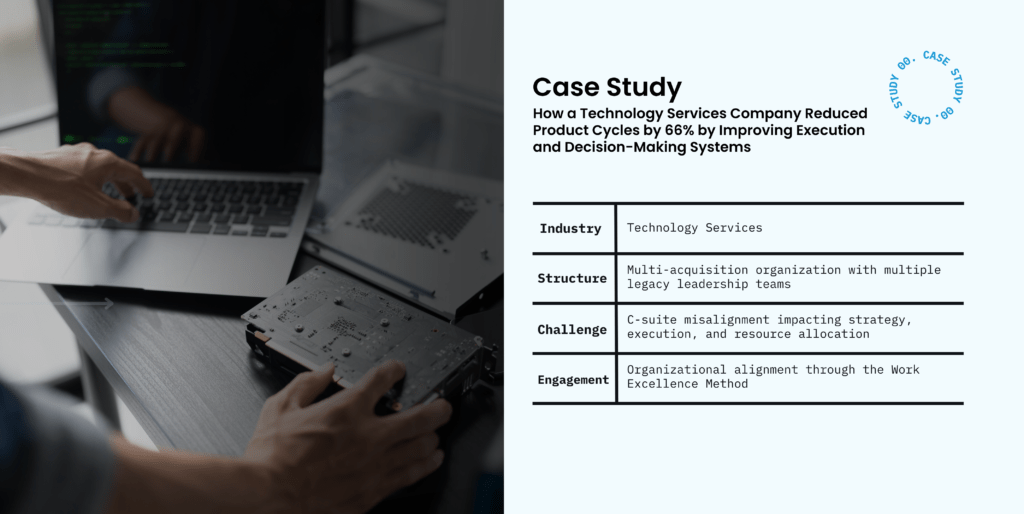
Challenge:
A technology services company engaged Work Excellence to support a rebranding initiative following a series of acquisitions. Early in the engagement, a deeper issue emerged. With multiple CEOs from acquired companies joining the executive team, there was no unified way of thinking, working, or making decisions. Each leader brought their own processes, priorities, and perspectives, creating fragmentation at the top of the organization.
This misalignment led to:
- Inefficient go-to-market strategies
- Conflicting priorities across teams
- Resource misallocation
- Slow and inconsistent execution
Without a shared structure for decision-making and execution, teams became stuck in cycles of rework, stalled initiatives, and wasted effort.
Approach:
Recognizing that rebranding alone would not solve the underlying issue, Work Excellence shifted the focus to improving how the business operates at the leadership level. Rather than focusing on theoretical alignment, we worked directly on the business, clarifying priorities, structuring workflows, and improving how decisions are made.
Using the Work Excellence Method, we:
- Built a structured system for defining organizational priorities and success metrics
- Worked with leadership in real-time to improve decision-making and execution
- Integrated these systems into existing routines to ensure immediate impact
Solution:
By introducing a structured system for priorities, workflows, and decision-making, the organization established:
01. Clear Organizational Direction
Leadership aligned on core priorities, product focus, and strategic objectives across the business.
2. Defined Workflows and Measurement Systems
Teams gained visibility into how work moved across the organization and how success was measured.
03. Consistent Decision-Making Frameworks
Executives adopted a shared approach to decision-making, reducing friction and accelerating execution.
As alignment strengthened at the executive level, the organization expanded the method to L2 leaders, creating consistency across departments and scaling alignment throughout the company.
Results
The impact on execution and performance was immediate and measurable:

Product development cycles reduced from 18 months to 6 months

Marketing production time reduced from 3–4 weeks to 3 days

More effective executive meetings and improved communication with the board
With clear direction and aligned systems, the organization shifted from reactive, fragmented work to focused, strategic execution.
What This Means for Leaders
Most organizations don’t struggle with effort. They struggle with how the business is being run.
As companies grow through acquisitions, complexity increases, but leadership teams often lack a consistent way to prioritize, make decisions, and execute. This leads to slow progress, rework, and misaligned teams, even when talent is strong. This case shows that improving performance comes from improving how work is structured and decisions are made.
Key Takeaways:
✓
Execution slows when priorities and decision-making are not clearly defined.
✓
Growth amplifies operational gaps, especially across leadership teams.
✓
Improving how work is structured drives faster results.
Execution speed is often a function of clarity in priorities and decision-making. Taking time to evaluate how those are defined across leadership is often where the biggest performance gains are found.